샤수족 관련 자료
샤수족 관련 자료


//
https://biblearchaeology.org/research/exodus-from-egypt/3233-the-name-yahweh-in-egyptian-hieroglyphic-texts?highlight=WyJvbGQiLCInb2xkIiwib2xkJyIsIidvbGQnIiwib2xkJy1tb3VudGFpbnMiLCJ0ZXN0YW1lbnQiLCJ0ZXN0YW1lbnQnIiwib2xkIHRlc3RhbWVudCJd
//
이집트 상형문자에 나오는 야훼라는 이름
- 범주: 기원전 1446-1406년 모세의 출애굽과 광야 방랑
샤수(Shasu)라는 용어는 주로 시리아-팔레스타인의 유목민 또는 반유목민을 지칭하는 유목민 또는 베두인족을 의미하는 것으로 일반적으로 받아들여지고 있습니다. 신왕국 시대의 문헌에는 '야훼의 샤수의 땅'이라고 불리는 지역에 대한 두 가지 중요한 상형문자 언급이 있습니다. 구약 성경을 제외하고 , 이것은 야훼 신에 대한 고대 문헌에서 발견되는 가장 오래된 언급입니다. 이 논문의 목적은 이 두 참고 문헌을 연구하고 출애굽기 기록의 연대를 측정하는 데 있어서 그 둘의 중요성을 평가하는 것입니다.
이 기사는 원래 Artifax 2009년 가을호에 게재되었습니다 . 허가를 받아 게시했습니다.
소개
신왕국 시대의 외국인 유형에 대한 고대 이집트의 명칭 중에서 샤수(Shasu)라는 용어가 상당히 자주 등장합니다. 샤수(Shasu)라는 용어는 주로 시리아-팔레스타인의 유목민 또는 반유목민을 지칭하는 유목민 또는 베두인족을 의미하는 것으로 일반적으로 받아들여지고 있습니다. 신왕국 시대 문헌에는 “야훼의 샤수의 땅”이라고 불리는 지역에 대한 두 가지 중요한 상형문자가 언급되어 있습니다. 1 구약 성경을 제외하고 , 이것은 고대 텍스트에서 야훼 신에 대한 가장 오래된 언급입니다. 이 논문의 목적은 이 두 참고 문헌을 연구하고 출애굽기 이야기의 연대를 측정하는 데 있어 그 중요성을 평가하는 것입니다.
샤수라는 용어
샤수(Shasu)라는 용어는 투트모스 3세, 아멘호테프 2세, 투트모스 4세, 아멘호테프 3세, 아케나톤, 세티 1세, 람세스 2세, 메르넵타, 라메세스 3세의 군사, 행정, 외교 문서를 포함한 다양한 신왕국 상형 문자 텍스트에서 발견됩니다. Shasu를 언급하는 19왕조 문서 중 가장 흥미로운 것 중 하나는 기원전 1192년에 작성된 편지로, 그 내용 중 일부는 다음과 같습니다.
나의 주님과의 또 다른 통신: 우리는 에돔의 샤수 부족들이 Tjeku에 있는 Merneptah Hotep-hir-Maat의 요새를 통과하여 Tjeku에 있는 Merneptah Hotep-hir-Maat의 Per Atum 연못으로 가는 것을 마쳤습니다. Tkeku, 그들을 살리고 그들의 가축을 살리려고 ... 2
여기서 샤수 부족은 이스라엘 사람들과 잘 알려진 관계를 맺고 있는 부족 민족인 에돔 사람들과 연결되어 있다는 점에 유의하십시오. 또한 이 샤수 부족들은 국경을 넘어 이집트 영토로 들어간 후 Tjeku의 Per Atum, 또는 성서 용어로 표현하면 Succoth의 Pithom에 정착했다는 점에 유의하십시오. 3 또한 이 샤수 에돔 사람들은 동물을 치는 사람들이었으며, 물론 그들도 셈족이었다는 점에 유의해야 합니다.
출애굽기 1장 11절에 따르면, 비돔과 인근 도시 라암셋은 이스라엘 사람들이 이집트에서 속박되어 있던 동안 바로를 위해 건설한 두 개의 “저장 도시”였습니다. 또한, 위의 본문을 번역한 독일 학자 지그프리트 헤르만(Siegfried Herrmann)은 샤수 에돔 사람들이 정착한 체쿠 지역을 창세기 46장 34절에 언급된 고센 땅의 일반 지역과 동일시했습니다. 4 파라오의 관리들이 에돔 사스 사람들을 대하는 방식은 바로가 이전에 요셉 시대에 이집트에서 이스라엘 사람들을 대했던 방식을 연상시킵니다.
이집트 문헌에는 이집트 남부 누비아 지역에 살고 있는 샤수 유목민에 대한 언급이 몇 군데 있지만, 대부분의 언급은 이집트 북쪽에 살고 있는 샤수에 대한 것이며 이 논문의 초점은 바로 이들 샤수입니다.
이집트 텍스트에서 Shasu라는 용어의 사용에 대한 훌륭한 연구를 보려면 ARTIFAX 에 게재된 Kenneth R.Cooper의 The Shasu of Palestine in Egypt Texts 라는 제목의 두 부분으로 구성된 기사 시리즈를 참조하세요 . 5 쿠퍼가 지적한 것처럼, 대부분의 이집트 학자들은 샤수라는 이름을 “방랑하다”를 의미하는 이집트 동사에서 파생하여 “유목민” 또는 “베두인족”으로 번역합니다.
그러나 샤수에 관해 글을 쓴 대다수의 학자들은 그들이 완전한 유목민은 아니었음을 강조합니다. 이집트 지형 문헌에는 샤수족과 관련된 특정 지리적 영역이 있었으며, 이는 적어도 일부 샤수족이 정의된 지역에 어느 정도 정착하여 살았음을 나타냅니다. 아마도 '반유목민'이 더 정확한 번역일 것입니다. 6
샤수라는 용어는 주로 이집트 북부에 살았던 반유목민 셈족 목동들에게 사용되었지만, 일부 신왕국 문헌에서는 샤수족이 살았던 지역을 가리키는 이차적인 용도도 있습니다. 이집트 문헌에서 지리적으로 사용될 때는 상형문자 t3이 사용되며, 이 단어는 "~의 땅"으로 번역되어야 합니다. 우리가 논의하고 있는 이 두 가지 참고 문헌의 경우 이집트 문구는 t3 sh3sw ya-h-wa, 즉 입니다 . “여호와의 사수의 땅.”
샤수(Shasu)라는 용어는 레바논, 시리아, 시나이, 가나안, 트랜스요르단 지역에 거주하는 반유목민을 가리키는 신왕국 문헌에서 거의 독점적으로 사용됩니다. 이 지역에 거주하는 유목민을 가리키는 용어인 샤수(Shasu)라는 용어는 이집트인들이 셈족 목동으로 확실히 식별할 수 있는 종족 그룹에만 거의 독점적으로 사용한 것으로 보입니다.
신왕국 문헌을 보면 샤수족이 이집트 정부의 통제를 받는 경우가 거의 없었고 거의 항상 이집트인의 적으로 여겨졌음이 분명합니다. 예를 들어, ca.의 유명한 Kadesh 전투에서. 기원전 1275년, 람세스 2세에 맞서 히타이트의 동맹이었던 샤수 병사들이 있었습니다.
신왕국시대 이집트인들은 에돔족, 암몬족, 모압족, 아말렉족, 미디안족, 겐족, 하피루족, 이스라엘족을 모두 샤수족으로 분류했을 가능성이 있다. 이 목록에는 아마도 아모리인과 아람인도 포함되어야 할 것입니다. ca에 대한 언급도 있습니다. 기원전 1250년 파피루스 아나스타시 1세(Anastasi I)는 출애굽 당시 이스라엘 사람들이 만난 거인과 동일시될 수 있는 가나안에 살고 있는 거인 샤수(Shasu) 그룹에게 전달되었습니다. 7
여호와의 샤수의 땅
“야훼의 샤수 땅”을 언급하는 두 개의 새 왕국 비문은 지형 목록에서 발견됩니다. 한 목록은 Soleb에 있고 두 번째 목록은 Amarah-West에 있습니다.
아몬-레(Amon-Re) 신에게 바쳐진 사원인 솔레브(Soleb)는 기원전 100년에 파라오 아멘호테프 3세(Pharaoh Amenhotep III)에 의해 지어졌습니다. 기원전 1400년. 오늘날 그것은 수단 국가의 와디할파(Wadi-Halfa)에서 남쪽으로 약 135마일 떨어진 나일강 좌안에 위치하고 있습니다.
역시 수단에 위치한 아마라-웨스트(Amarah-West)는 기원전 13세기 람세스 2세가 건설한 것으로 방대한 지형 목록이 새겨져 있습니다. "야훼의 사수의 땅"에 대한 언급이 포함된 아마라-서쪽 지형 목록의 섹션은 솔렙의 이전 목록에서 거의 확실하게 복사되었습니다.
이 시점에서 이집트학자들은 일반적으로 이 두 목록에 야훼라는 이름이 나타나는 것에 대해 의문을 제기하지 않는다는 점에 유의해야 합니다. 예를 들어, Donald Redford는 Soleb에서 야훼에 대한 언급을 다음과 같이 썼습니다.
반세기 동안 이스라엘의 신 “야훼”의 이름인 테트라그람마톤이 여기에 있다는 것이 일반적으로 인정되어 왔습니다. 만약 그렇다면, 의심할 여지 없이 이 구절은 기원전 15세기 후반에 이 신을 숭배하는 영토가 어디에 있었는지에 대한 가장 귀중한 표시가 됩니다.
레드포드는 야훼의 샤수를 에돔 사람들과 동일시하고 야훼가 처음에는 에돔 사람들의 신으로 숭배되었다고 주장합니다. 그는 또한 에돔 족속의 한 지파가 에돔 족속의 본체에서 갈라져 북서쪽으로 이동하여 그들의 신 야훼를 데리고 이스라엘 족속의 한 지파가 되었다고 주장한다. 레드포드에게 이것은 야훼가 어떻게 이스라엘 사람들의 하나님이 되었는지 설명합니다. 9
레드포드의 입장에는 몇 가지 문제가 있으며, 이것들은 나중에 다루어질 것입니다. Soleb과 Amarah-West에서 야훼라는 이름의 출현에 의문을 제기하는 학자가 거의 없다는 점을 여기서 언급하는 것으로 충분합니다.
"야훼의 샤수 땅"의 위치와 관련된 이집트 지형 목록의 지명에 대한 가장 좋은 논의는 1979년에 출판된 Festshrift Elmar Edel 의 장에서 Michael Astour의 논의입니다. Astour는 그 장소가 다음과 같이 지적합니다 . Soleb 및 Amarah-West에 나열된 이름에는 시리아-팔레스타인의 이집트 소유물과 해당 지역의 비이집트인이 통제하는 인종 그룹 및 지역이 모두 포함됩니다.
가장 관심을 끄는 지형 목록은 "t3 Sh3sw of X" 또는 "Land of the Shasu of X"라고 읽는 텍스트 그룹입니다. 여기서 X는 일반적으로 장소입니다. Astour는 다른 학자들이 말한 것과 달리 Donald Redford가 좋은 예이며 Amenhotep III에 의해 언급되고 Rameses II에 의해 복사된 모든 Shasu 땅이 시리아, 레바논, 가나안, 시내산, 트랜스요르단. 10
이집트학자들은 솔렙과 아마라-웨스트의 지형 목록에 야훼라는 이름이 나타나는 것을 인정하지만, 그 출현이 암시하는 의미는 구약 성서 학자 들에 의해 충분히 이해되지 않은 것 같습니다 . 물론 질문은 남습니다. 야훼라는 단어가 누구 또는 무엇을 지칭하는가? 그것은 이스라엘의 하나님을 가리키는 것인가? 아니면 t3 sh3sw 로 시작하는 다른 지명과 마찬가지로 도시나 도시를 가리키는 것일까요 ?
즉, t3 sh3sw ya-h-wa 라는 문구를 “야훼 신을 경배하는 유목민의 땅”으로 번역해야 할까요, 아니면 “야훼의 지역에 사는 유목민의 땅”으로 번역해야 할까요? 이에 대한 대답은 절대적으로 확실하게 알려져 있지 않지만, 비록 야훼가 이 상형 문자 텍스트에 있는 장소라고 하더라도 그것은 분명히 구약 의 야훼 신의 이름을 딴 장소였습니다 . 그보다 적은 것은 너무 우연인 것 같습니다. 그러나 Soleb 및 Amarah-West의 목록에서 Astour가 제안한 다른 t3 Sh3sw 지명 의 위치를 살펴보겠습니다 .
Astour는 Rameses II의 Amarah 목록과 Amenhotep III의 Soleb 목록을 연관시킵니다. 그는 또한 이 두 목록을 룩소르의 나일강 서쪽 강둑에 있는 메디네트 하부(Medinet Habu)에 있는 그의 거대한 영안실 사원에 위치한 람세스 3세의 부분적이지만 부분적인 지형학적 목록과 연관시킵니다.
먼저 Amarah 및 Soleb 목록의 병렬 부분에 대한 Astour 상관 관계를 살펴보겠습니다. 두 목록 모두 t3 sh3sw pys-pys 라는 장소로 시작합니다 . Astour는 이를 현대 레바논의 Litani 강 근처 Biqa Valley의 샘으로 식별합니다. 11 그곳은 분명히 가나안 북쪽에 위치해 있습니다.
두 목록의 두 번째 장소는 Astour가 정확한 위치에 대해 다시 확신하는 Sa-ma-ta 입니다. 그는 Sa-ma-ta를 Batrun에서 남쪽으로 약 7마일 떨어진 페니키아 해안에 있는 유적지인 Samat와 동일시합니다. 이 장소는 일반적으로 페니키아인으로 간주되는 지역인 가나안 북쪽에 위치하고 있으며 다시 에돔에서 멀리 떨어져 있습니다. 12
세 번째 지명이자 우리가 가장 관심을 두는 지명은 “야훼의 사수의 땅”이다. Astour는 이 종족 그룹을 찾으려고 시도하지 않으며 그럴 만한 이유가 있습니다. 오늘날 전체 지역에는 야훼라는 이름이나 이와 유사한 이름을 지닌 지형학적 장소가 없습니다. 또한 야훼라는 지형적 장소를 언급하는 성서적 참고 자료나 고대 역사적 자료도 없습니다. 우리는 나중에 이 점으로 돌아올 것입니다.
Astour는 Yahweh라는 이름이 Medinet Habu(기원전 12세기)의 지형 목록에도 변형 철자 yi-ha 와 함께 나타나는 것을 관찰합니다 . 13 이것은 상형 문자 본문에서 야훼에 대한 세 번째 언급을 구성합니다. 그러나 메디넷 하부 목록에는 '샤수의 땅'이라는 문구가 생략되어 있다.
Astour는 yi-ha가 Soleb 및 Amarah-West 지형 목록에서 발견되는 ya-h-wa 의 변형일 뿐이라고 믿습니다 . 그는 또한 " Tu-ra/Tu-ra-ba-ar 의 샤수 땅 "이라고 불리는 장소의 일부 버전이 세 목록 모두에서 뒤따르기 때문에 동일한 사람들을 지칭한다고 믿습니다. 그러나 Medinet Habu 목록에서는 이 장소 전체 이름의 마지막 요소에서 Tu-ra라는 이름을 실수로 분리했습니다. 투라바아르(Tu-ra-ba-ar) 는 이 한 지역을 두 곳으로 만들었습니다. 그럼에도 불구하고 전체 이름 t3 shsw tu-ra-ba-ar는 Soleb 및 Amarah 목록 모두에서 야훼를 언급하는 장소 뒤에 나타납니다.
Astour는 Tu-ra-ba-ar를 Turbul이라는 이름으로 식별했습니다 . 이집트 언어에는 L 소리가 없으며 일상적으로 L 소리에 R을 사용한다는 점을 기억해야 합니다. Astour는 고대 Tu-ra-ba-ar 의 가능한 위치가 두 군데 있으며 둘 다 현대 이름인 Turbul을 가지고 있다고 말합니다. 하나는 레바논의 비카 밸리(Biqa Valley)에 위치하고 있고 다른 하나는 조금 더 북쪽이지만 레바논에도 있습니다. 14
이 시점에서 Amarah-West 목록이 Shasu 토지 섹션의 머리 부분에 Soleb의 이전 텍스트에서는 발견되지 않은 두 개의 추가 Shasu 위치를 제시한다는 점을 관찰해야 합니다. 첫 번째인 Sa-ar-ar는 언어학적으로 식별하기 어렵습니다. 레드퍼드를 포함한 일부 학자들은 이곳을 에돔의 세일 산과 동일시했지만, 다른 동일시도 제안되었습니다. 15 그러나 이 지명이 세일 산을 가리켜 에돔을 가리키는 것이라면, 이집트인들은 여호와의 사수 땅과 에돔 사수 땅을 구별하고 있었던 것 같습니다.
Soleb에서 발생하지 않는 Shasu 사이트의 Amarah 목록에 있는 또 다른 항목은 ra-ba-na 입니다 . 그러나 이 용어는 Medinet Habu에서 발생하며 Astour는 이를 시리아 중부의 도시 국가인 Labana와 동일시합니다.16 다시 이것은 Shasu 민족과 그들의 토지가 지역 전체에 퍼져 있었고 단지 에돔 지역에만 국한되지 않았음을 보여줍니다. 그리고 시나이.
이제 여호와의 사수의 땅에 관해 몇 가지 결론을 내리겠습니다. 야훼와 같은 지리적 용어가 확인되지 않았기 때문에 이는 상형 문자 문구 t3 sh3sw ya-h-wa가 "야훼 신을 숭배하는 유목민의 땅"으로 번역되어야 함을 시사합니다. 여호와의 땅에 사는 유목민이라.” 게다가 야훼와 같은 지리적인 용어가 확인되지 않았다는 사실은 솔렙과 아마라 본문에 나오는 야화와라는 단어가 실제로 이스라엘의 하나님에 대한 초기 언급일 가능성을 강화합니다.
Astour가 지적한 것처럼, Soleb에서 야훼에 대한 언급은 잘 알려진 모압 돌의 야훼에 대한 언급보다 500년 전이며, 따라서 그것은 야훼라는 이름이 비성서적으로 등장한 최초의 사건입니다. 이집트 문헌에 나오는 야훼가 장소라고 하더라도, 그러한 지역, 도시, 마을이 구약성서의 야훼의 히브리 신의 이름을 따서 명명되었다는 것은 거의 확실한 것 같습니다 . 따라서 우리는 구약 성서 밖에서 발견된 야훼의 하나님에 대한 최초의 언급을 여전히 갖고 있을 것입니다 .
|
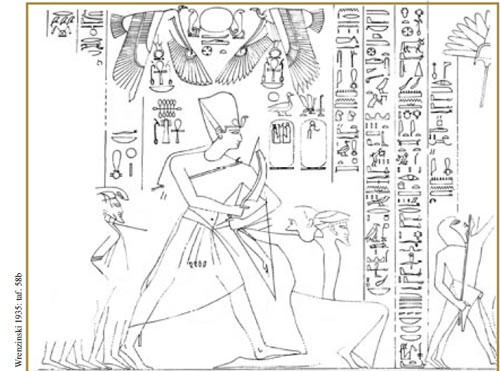 |
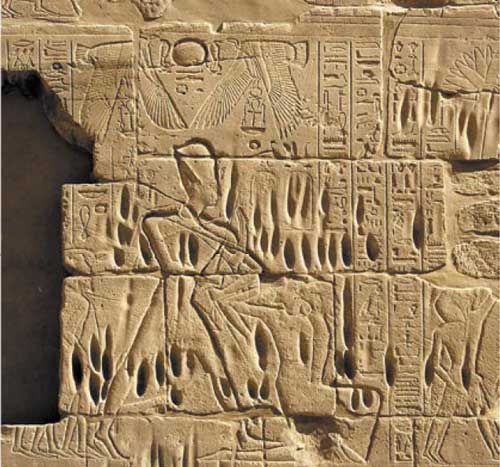
카르나크 신전에 있는 파라오 메르넵타의 가나안 전투 부조의 장면 5. Merenptah는 Shasu 포로를 묶어 이집트로 가져갑니다. 오른쪽 위 그림, 왼쪽 그림. 사막에 거주하는 샤수족은 턱수염을 기르고 짧고 종종 술이 달린 킬트나 발목 길이의 옷과 터번을 착용하는 것으로 묘사됩니다. 장면 옆에 있는 텍스트는 주로 수사적이며 왕의 미덕을 찬양합니다. 그들은 부분적으로 "힘센 황소, 날카로운 뿔을 갖고 단호하며 아시아인들을 짓밟는다...그는 쿠루(= 팔레스타인)의 족장들이 입으로 자랑하는 것을 그치게 한다"고 말합니다. 사진: 마이크 루데니
|
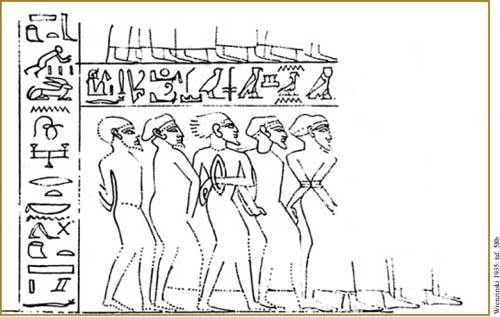
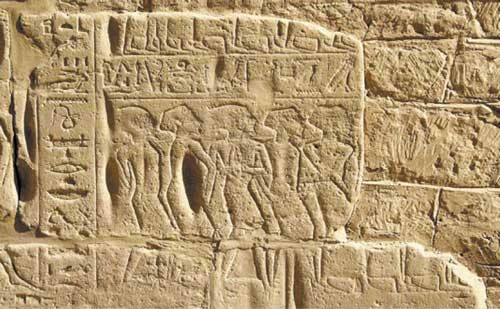
카르나크 신전에 있는 파라오 메르넵타의 가나안 전투 부조. 장면 8, 샤수 포로, 위 왼쪽 그림, 아래 그림. 원래 메렌프타가 아문 신에게 포로들을 바치는 모습을 묘사했을 더 큰 장면의 일부. 이 장면에 속할 수 있는 느슨한 블록의 텍스트는 부분적으로 "그의 아버지 아문이 비열한 레테누(시리아) 땅과 외국 땅의 추장들로부터 돌아왔을 때 폐하께서 공물을 바치신 것"이라고 되어 있습니다. . 사진: 마이크 루데니
이집트 혼합주의와 야훼 하나님
이 시점에서 외국 신과 여신에 대한 이집트의 언급을 살펴보고 그들이 일반적으로 어떻게 대우받았는지 살펴보는 것은 가치가 있습니다. Kenneth Ostrand는 2006년 KMT 잡지에 고대 이집트의 외국 신들에 대한 연구를 발표했습니다. 17 그 중 네 가지를 조사해 보겠습니다.
셈족 이슈타르(Ishtar) 및/또는 수메르인 이난나(Inanna)에서 진화한 것으로 추정되는 서부 셈족 여신 아스타르테(Astarte)는 사랑과 다산의 여신이었습니다. 그녀는 기원전 15세기 아멘호테프 2세(Amenhotep II)의 통치 때까지 이집트 문헌에 나타나지 않습니다. 그 때 그녀는 왕의 유명한 스핑크스 비석에서 왕의 자랑스러운 승마 기술에 기뻐하는 것으로 언급됩니다. 신왕국 시대에 아스타르테는 세트의 배우자이자 Re의 딸이 되었다는 점에 주목하는 것이 중요합니다. 그녀와 세트의 관계는 두 신의 호전적인 성격과 관련이 있을 가능성이 있습니다. 이집트 예술에서 아스타르테는 머리에 왕관을 쓰고 다양한 무기를 들고 말 위에 서 있는 모습으로 묘사됩니다. 그녀를 위한 신전은 성서에 나오는 라암세스인 텔엘다바에 세워졌는데, 이 도시는 이스라엘 사람들과 힉소스와 관련된 도시였습니다. 라암셋은 제19왕조의 이집트 수도이기도 했습니다.
이집트에서 존경받는 또 다른 서부 셈족 여성 전사 신은 아나트(Anath)인데, 그는 중왕국 후기에 등장했는데, 아마도 셈족이 이집트로 유입되어 결국 소위 힉소스 시대(Hyksos period)를 낳은 일부일 것입니다. 제18왕조에서 잠시 중단된 후, 아나트는 제19왕조에서 세티 1세와 그의 아들 라메세스 2세의 군사적 승리로 인정받으며 다시 인기를 얻었습니다. 그녀의 숭배의 중심은 델타였습니다. 아나트 숭배의 성적인 성격 때문에, 아나트는 성적인 성향을 지닌 여러 이집트 신들인 민(Min), 하토르(Hathor), 세트(Set)의 동료로 여겨졌습니다. 그녀는 이집트 전통 드레스를 입고 있거나 아무것도 입지 않은 것으로 묘사되었습니다. 그녀는 또한 창이나 전투 도끼와 같은 무기를 들고 있는 경향이 있었습니다.
가나안의 전쟁과 천둥의 신인 레셰프(Reshef)는 힉소스(Hyksos)에 의해 이집트에 소개된 것 같습니다. 지하 세계의 왕인 레셰프는 인류에게 역병과 전쟁을 가져올 것으로 생각되었습니다. 이집트인들은 그를 킬트, 수염, 뿔 달린 투구 등 뚜렷한 시리아 스타일로 묘사했지만, 상이집트의 흰 왕관을 쓰고 이집트의 앙크와 홀을 들고 있거나 때로는 가나안 무기를 들고 있는 모습으로도 묘사될 수 있었습니다. 이것은 레셰프가 민(Min) 신과 카데쉬(Qadesh) 여신과 함께 삼위일체 신의 일원으로 삽입된 것과 함께 이집트 판테온에 외국 신들이 혼합주의적으로 통합된 정도가 뚜렷하다는 것을 보여줍니다.
훨씬 더 알려지지 않은 지역의 신들도 이집트에서 숭배될 수 있었습니다. Ostrand가 인용한 예는 중왕국 시대에 이집트에 들어간 리비아의 신 Ash입니다. 그는 당연히 사막 지역과 오아시스의 신이었으며 결국 이집트 신 세트와 완전히 동일시되었습니다. 고대 이집트인들은 애쉬를 매나 뱀 머리를 가진 사람, 때로는 사자나 독수리로 묘사했습니다.
이 모든 것은 이집트인들이 외국 신들에게 신전을 짓고, 이집트의 특성을 부여하고, 자신의 신 및 여신과의 유사성을 강조하고, 때로는 그들을 자신의 신과 완전히 동일시하는 것을 포함하여 외국 신을 완벽하게 기꺼이 숭배했음을 보여줍니다.
고대 이집트인들이 다른 나라의 신들에 대해 일반적으로 혼합주의적으로 수용한 것을 연구하고, 외국 신들에 대한 혼합주의적 수용을 연구하고, 야훼가 받은 대우와 비교함으로써, 야훼가 어떤 이유로 매우 다르게 대우받았음을 인식할 수 있습니다. 분명히 이집트인들은 Soleb, Amarah-West 및 Medinet Habu 지형 목록에서 볼 수 있듯이 야훼에 대해 알고 있었지만 그를 숭배하지 않았으며 분명히 그를 숭배하고 싶지도 않았습니다.
야훼는 이집트의 어떤 신과 동일시되거나 동일시되지도 않았습니다. 이집트인들이 야훼를 위한 신전을 지은 적도 없었고, 야웨에 대한 어떤 예술적 표현도 없었으며, 사실 이집트 문헌에는 야훼에 대한 어떤 논의도 없었습니다. Soleb, Amarah-West 및 Medinet Habu에서 발견된 지형적 참고 자료 외에 이집트 문헌에는 그에 대한 다른 언급이 없습니다. 고대 이집트인들은 야훼만을 하나의 범주에 두었던 것으로 보인다. 적어도 이것은 혼합주의 이집트인들에게는 매우 이상합니다. 가능한 설명은 이집트인들이 야훼를 이집트 북쪽에 살았던 미움받는 샤수족의 일부인 적 부족 집단의 적 신으로 보았다는 것입니다.
여호와는 지명이었는가?
야훼라는 이름과 연결될 수 있는 현대적, 고대적 지명이 없다는 점은 의미심장해 보입니다. 실제로 Astour와 다른 사람들이 항상 "Land of the Shasu of X"라는 문구 끝에 지명을 제공하려는 시도가 말 앞에 카트를 두는 것이 아닌지 궁금합니다.
아마도 우리가 현재 이러한 지형 목록에서 지명으로 받아들이는 것은 원래 다른 것, 아마도 샤수 유목민/베두인의 특정 그룹에 붙게 된 신의 이름이거나 동명의 조상의 이름이었을 것입니다. 예를 들어, 사마타(sa-ma-ta) 는 샤수(Shasu) 그룹의 리더이거나 다른 중요한 인물이었으며 그의 이름은 나중에야 물리적 위치에 부착되었습니까? 이것이 바로 이스라엘이라는 이름에 일어난 일이라는 점에 유의해야 합니다. 처음에는 동명의 조상의 이름이었으나 나중에는 지명이 되었다.
아마도 원래 "X 샤수의 땅"이라는 문구가 나타내는 용어 중 야훼라는 이름을 포함한 지명은 없었을 것입니다. 이러한 가능성은 상형문자 t3 sh3sw ya-h-wa 가 "한 장소에 사는 샤수족의 땅"으로 해석되기보다는 "야훼 신을 숭배하는 샤수족의 땅"으로 해석될 수 있고 아마도 해석되어야 함을 다시 한번 시사합니다. 여호와라 불렀느니라.” 어쨌든 Soleb과 Amarah-West의 지형학적 목록에서는 의심할 여지 없이 야훼라는 이름을 사용하고 있으며, 이 야훼는 거의 의심할 여지 없이 구약성서에 나오는 이스라엘 사람들의 하나님 입니다 .
야훼의 샤수는 누구였는가?
도널드 레드포드(Donald Redford)는 자신의 저서 이집트, 가나안, 고대 이스라엘에서 야훼의 샤수(Shasu)가 아주 초기에 야훼 신을 숭배했던 사람들이었다고 가정합니다. 레드포드는 또한 이러한 초기 야훼 숭배자들이 원래 기원전 15세기에 에돔 일반 지역에 살았던 에돔 족속이었다고 주장합니다. 레드포드는 다음과 같이 씁니다.
그러나 궁극적으로 기원전 15세기에 기원을 둔 솔렙(Soleb)과 아마라(Amarah)의 목록은 샤수(Shasu)의 원래 밀집 지역이 트란스요르단 남부, 모압 평야와 에돔 북부에 있었음을 시사합니다. 18
여기서 Redford는 Soleb, Amarah-West 및 Medinet Habu 목록에 언급된 Shasu가 가나안, 레바논 및 시리아 일부에 흩어져 있으며 단지 에돔 지역에만 위치한 것이 아니라고 주장한 Astour와 모순됩니다. 레드포드는 야훼의 사수 땅이 에돔 일반 지역에 위치했다고 가정할 뿐만 아니라, 최초의 야훼 숭배자들도 에돔 사람들이었다고 가정합니다. 그런 다음 그는 계속해서 야훼 숭배가 북서쪽으로 이주한 에돔 지파에 의해 가나안 산의 원시 이스라엘 사람들에게 소개되어 이들 원시 이스라엘 부족과 합쳐졌다고 주장합니다. 레드포드는 다음과 같이 씁니다.
유일하게 합리적인 결론은 이스라엘을 구성한 후기 혼합체의 주요 구성 요소 중 하나이자 야훼 숭배의 근원이 된 구성 요소가 이미 기원전 15 세기 말에 에돔의 샤수에서 찾아야 한다는 것입니다.
그러나 위에서 언급한 것처럼 Redford의 가정에는 문제가 있습니다.
첫째, 여호와의 사수가 에돔 사람이었다는 증거가 없습니다. 만약 그들이 에돔 사람들이었다면, 레드포드가 이 목록에 있는 t3 sh3sw sa-ar-ar 라는 문구 를 "세르의 샤수의 땅"으로 번역했기 때문에 아마라 서쪽의 목록에서 에돔 사람들이 이상하게 두 번 언급된 이유를 설명해야 합니다. .
Redford 자신이 지적했듯이 Se'ir는 구약 성서 에서 에돔의 또 다른 이름입니다 . Redford는 Amarah West에 대해 다음과 같이 썼습니다. "여기서 여섯 개의 이름 그룹이 "샤수 땅"에 있는 것으로 확인되었으며 여기에는 Se'ir(즉, 에돔)이 포함됩니다." 20 Redford가 이 문구를 번역한 것이 옳다면 위에서 언급한 것처럼 Amarah West에서 발견된 "X의 샤수 땅"에 대한 여섯 가지 언급에서 에돔 사람들이 이상하게도 두 번 언급됩니다. 물론 레드포드는 아마도 이 비판에 대해 "10세의 샤수 땅"에 대한 여섯 가지 언급은 모두 기원전 15세기에 에돔 일반 지역에 살았던 에돔 족속을 언급한 것이라고 대답했을 것입니다. Astour Strong이 거부했다고 가정합니다.
그리고 둘째, Sa-ar-ar가 Se'ir 산, 즉 에돔이 아닐 수도 있기 때문에 Redford의 에돔족 이론에는 큰 문제가 있습니다 . Astour는 Amarah의 목록에 철자가 표기되어 있는 방식 때문에 Sa-ar-ar를 Se'ir로 번역하는 것에 대해 질문합니다. Sa-ar-ar는 실제로 Se'ir 산이라면 Se'ir 산을 가리키는 특이한 이집트 철자입니다. Sa-ar-ar는 더 초기의 파라오 투트모시스 3세(Pharaoh Thutmosis III)의 지형 목록에서도 같은 방식으로 철자가 기재되어 있기 때문에 단순한 철자 오류로 설명할 수 없습니다. 21 사르아르가 세일이 아니었다 면 Astour가 말한 대로 그곳은 고대 에돔 지역에 위치하지도 않았을 것입니다.
Astour가 제공한 증거에 따르면, 야훼의 샤수(Shasu)가 에돔 사람들이었다는 레드포드의 이론은 이를 뒷받침하는 것이 거의 없습니다. 그러면 여호와의 사수는 누구였습니까?
여호와의 샤수와 출애굽 날짜
야훼의 샤수에 대한 상형문자 언급을 다룰 때 구약 성서 학자들이 직면해야 할 두 가지 확실한 사실이 있습니다 . 첫째, 솔레브(Soleb)와 아마라-웨스트(Amarah-West)의 상형문자 텍스트에 이스라엘 신 야훼(Yahweh)의 이름이 나타나고, 아마도 메디네트 하부(Medinet Habu)에도 나타난다는 것은 의심의 여지가 없습니다. 둘째, Soleb에서 야훼에 대한 언급은 ca. 기원전 1400년 파라오 아멘호테프 3세 통치 기간. 즉, 파라오 아멘호테프 3세나 적어도 그의 서기관들은 적어도 기원전 100년경에 히브리 신 야훼에 대해 들어봤음에 틀림없습니다. 기원전 1400년. 이 사실은 모세 시대에 이스라엘 백성이 이집트에서 탈출한 시기를 추정할 때 매우 중요합니다.
출애굽기 5장 2절에서 바로는 이스라엘 백성들이 여호와를 경배하기 위해 광야에 나가도록 허락해 달라는 모세의 첫 번째 요청에 “여호와가 누구이기에 내가 그의 목소리를 듣고 이스라엘을 보내겠느냐?”라고 대답합니다. 나는 여호와를 알지 못하며, 게다가 이스라엘 자손도 보내지 않을 것이다.” 22 바로는 여기서 자신이 여호와 하나님에 대해 들어본 적이 없다고 말하고 있는 것 같습니다. 바로의 진술에 대한 이러한 해석은 하나님께서 바로에게 응답하시는 출애굽기 7장 17절에 의해 강화 됩니다 . 내 손에 있으니 피가 되리라.”(NASV)
두 번째 재앙 이후 모세와 아론과의 세 번째 만남에서 바로는 야훼가 일종의 신임을 분명히 인정하고 모세와 아론에게 개구리 재앙을 없애달라고 야훼께 기도해 달라고 요청했습니다(출애굽기 8:8 참조). 만약 출애굽의 파라오가 이전에 야훼 하나님에 대해 들어본 적이 없었다면, 이는 출애굽의 날짜가 ca. 기원전 1400년 파라오 아멘호테프 3세가 ca에서 야훼에 대해 분명히 들었기 때문입니다. 기원전 1400년.
결론
시리아-팔레스타인에 한때 야훼라는 신이나 장소와 관련된 샤수 베두인/유목민 집단이 있었다는 것은 분명합니다. 또한 야훼라는 이름이 파라오 아멘호테프 3세의 통치 기간인 제18왕조의 이집트인들에게 알려졌음도 분명합니다.
그러나 이 시점에서 우리는 또한 구약 에서 이집트로 가지 않고 출애굽 당시 이집트를 떠나지 않은 가나안의 다른 야훼 숭배자들이 있었다는 것을 알고 있다는 것을 인정해야 합니다 . 따라서 질문이 생깁니다. 그들은 아마도 솔렙과 아마라에서 언급된 야훼의 샤수였을까요?
비록 우리가 원했던 모든 정보를 갖고 있지는 않지만, 아멘호테프 3세의 통치 이전 이집트 문헌에 야훼의 샤수에 대한 언급이 없다는 점은 중요합니다. 문제의 그룹이 이집트에 가본 적이 없는 야훼 추종자라면 왜 18왕조 초기의 지형 목록, 예를 들어 투트모시스 3세의 광범위한 지형 목록에 그들이 없는 걸까요? 그 이유는 야훼의 샤수(Shasu)가 실제로 이스라엘 사람들이었고, 그들이 18왕조 초기에도 여전히 이집트에 살고 있었기 때문일 것입니다.
야훼의 샤수(Shasu)가 ca.에서 Amenhotep III 시대의 지형학적 목록에 처음으로 나타난다는 사실. 기원전 1400년은 출애굽의 초기 날짜와 완벽하게 일치하지만, 이 사실은 출애굽이 기원전 13세기 파라오 람세스 2세의 통치 기간에 일어났다고 믿는 학자들에게 큰 문제를 제시합니다. 어쨌든, 야훼에 대한 이러한 언급은 보수적이거나 진보적인 성경 학자들 모두에 의해 너무 오랫동안 무시되어 왔습니다.
따라서 Soleb과 Amarah-West의 지형 텍스트에 언급된 야훼의 샤수는 기원전 1400년경에 가나안 산에 있는 자신들의 땅(t3)에 정착한 이스라엘 사람들이었을 가능성이 매우 높습니다 . 또한 고대 이집트인들에게 있어 이스라엘 사람들을 이 지역의 다른 모든 샤수(셈족 목동들)와 구별시키는 한 가지 특징은 야훼 하느님을 숭배한 것 같습니다.
미주
1. Michael C. Astour, Festschrift 의 이집트 지형 목록 에 있는 Yahweh Elmar Edel in Agypten und Altes Testament , Manfred Gorg 편집(Bamberg, Germany, 1979. pp. 17-19. Astour는 이 기사에서 세 번째가 있음을 지적함) 기원전 12세기 초 람세스 3세의 Medinet Habu 지형 목록(19-20페이지)에서 Yahweh라는 이름을 사용했을 가능성이 있습니다. 그러나 이 기사 아래에서 볼 수 있듯이 Medinet Habu에서 Yahweh라는 이름은 " yi-ha.” 그러나 Medinet Habu에서는 “ yi-ha ”를 “샤수의 땅”이라는 문구 없이 사용합니다.
2. 이집트의 이스라엘 지그프리트 헤르만 (Naperville, IL: Alec R. Allenson Inc., 1973). 피. 25.
3. 이집트 이름 Tjekku와 히브리어 이름 Succoth를 동일시하려면 Donald B. Redford, Egypt, Canaan, and Israel in Ancient Times (Princeton, NJ: Princeton University Press, 1993), 19면을 참조하십시오. 203.
4. 헤르만(Herrmann), 이집트의 이스라엘 , pp. 26-27. Evangelischen Theologie 26(1966) 에 있는 Herrmann의 기사 Der Altestamentliche Gottesname도 참조하세요 . 289-291쪽.
5. Kenneth R. Cooper, 이집트 문헌에 나오는 팔레스타인의 샤수 , 1부, Artifax , 가을, 2006, Vol. 21, 4호, 22-27면; 및 2부, Artifax , Winter, 2007, Vol. 22, No. 1, pp. 24-29.
6. 쿠퍼(Cooper), 샤수(Shasu ), 1부, 24-25페이지.
7. WW 할로, 에디션. 성경의 맥락 (Leiden: Brill, 2003), Vol. 3, p. 9. Clyde E. Billington, Goliath and the Exodus Giants: How Tall Were 그들은 또한 참조하십시오 . 복음주의 신학학회지 , 48(2005), 505-506페이지.
8. 레드포드, 이집트, 가나안, 이스라엘 , p. 272.
9. 레드포드, 이집트, 가나안, 이스라엘 , 272-273쪽.
10. Astour, 야훼 , pp. 20-29.
11. Astour, 야훼 , p. 29.
12. Astour, 야훼 , p. 28.
13. Astour, 야훼 , p. 26.
14. Astour, 야훼 , 26-27쪽.
15. Astour, 야훼 , p. 21.
16. Astour, 야훼 , p. 23.
17. 케네스 오스트랜드, 이집트의 외계인 , KMT. 17.2, 2006년 여름, pp. 71-76.
18. 레드포드, 이집트, 가나안, 이스라엘 , p. 272.
19. 레드포드, 이집트, 가나안, 이스라엘 , p. 273.
20. 레드포드, 이집트, 가나안, 이스라엘 , p. 272.
21. Astour, 야훼 , p. 21.
22. 이 질문은 New American Standard 번역에서 따온 것입니다. 그러나 우리는 Lord라는 단어를 히브리어의 Yahweh로 대체했습니다.
기원 조사
- 참과 거짓 과학 >> 2020년 2월 4일
- 급속한 소진화와 적합성 비용 >> 2011년 6월 6일
- 희망 몬스터? >> 2011년 5월 11일
- 텍사스 홍수로 인해 협곡이 빠르게 형성됨 >> 2011년 4월 7일
- 열수분출구와 생명의 기원 >> 2011년 2월 23일
- 말라리아는 진화하고 있나요? >> 2010년 6월 15일
- 페름기-트라이아스기 멸종 연대 측정 >> 2010년 4월 12일
- RNA로부터 생명 창조 >> 2010년 2월 8일
사역 업데이트
- 2023년 가을 사역 업데이트 >> 2023년 10월 5일
- 2023년 봄 사역 업데이트 >> 2023년 6월 8일
- ABR의 메리 크리스마스 >> 2022년 11월 30일
- 2022년 봄 사역 업데이트 >> 2022년 6월 5일
- 2021년 봄 사역 업데이트 >> 2021년 5월 27일
- 크리스마스 예언 - 크리스마스 약속 >> 2020년 12월 6일
- 축복과 도전 >> 2020년 8월 12일
- Near East Archaeological Society 2019 요약 >> 2019년 12월 15일
판사 연합 군주제
- 사울 왕과 엔도의 마녀: 고대 세계의 강령술과 유령 구덩이 >> 2022년 11월 1일
- 사막의 불폭풍 >> 2022년 3월 15일
- 데이비드: 강력한 전사인가요, 아니면 동화 속의 영웅인가요? >> 2019년 12월 5일
- 이제 성경을 버려야 할 때입니까? 다윗 왕과 솔로몬: 남자인가 신화인가? 2부 >> 2014년 6월 11일
- 이제 성경을 버려야 할 때입니까? 다윗 왕과 솔로몬: 남자인가 신화인가? 1부 >> 2014년 5월 7일
- 사울과 다윗 시대의 엘라 골짜기 >> 2013년 2월 12일
- 구약의 왕이 발견되었나요? >> 2011년 2월 11일
- 블레셋 사람들이 가나안에 입성하다: 그들은 이집트의 하수인이었는가 아니면 침략하는 정복자들이었는가? >> 2010년 7월 12일
가부장제 시대
- 아브라함에게는 낙타가 있었는가? >> 2023년 6월 22일
- 창세기의 낙타는 그들이 속한 곳에 바로 있습니다 >> 2022년 3월 15일
- 요셉의 유산 계획(신성한 것을 위탁함) >> 2020년 3월 15일
- 소돔 찾기: 북부 제안에 대한 비판 >> 2016년 2월 26일
- 이스라엘인의 이집트 체류 기간 >> 2012년 1월 5일
- 족장 욥, 황동 납골 단지, 그리고 육체의 부활 >> 2011년 3월 23일
- 세겜: 고고학적, 맥락적 중요성 >> 2010년 6월 25일
- 이집트의 요셉 - 6부 >> 2010년 4월 9일
일반적인 변증
- 마약을 밧줄로 묶어? >> 2023년 6월 25일
- 예수 그리스도 부활의 역사성: 2부 >> 2021년 5월 1일
- 예수 그리스도 부활의 역사성: 1부 >> 2021년 4월 14일
- 메시아 부활의 예표 >> 2021년 3월 15일
- 성서는 혼합주의 문학인가? 역사적 유사점 이해 >> 2020년 5월 14일
- 영원한 진리에 대한 먼 기억 >> 2017년 10월 27일
- 앱 검토: iWitness 성서 고고학 >> 2017년 8월 22일
- 크리스마스의 진실과 현실 1 >> 2016년 12월 17일
창립자 코너
- 성경의 무오성에 관한 예수 그리스도 >> 2010년 8월 10일
- 고대 문학 본문과 구약성서의 연관성 >> 2010년 2월 19일
- 바이블 앤 스페이드 창간 40주년호 >> 2009년 10월 29일
- 베델의 전통적인 장소에 대한 질문 >> 2009년 7월 8일
- 성서에 나오는 베델과 아이의 위치가 재고됨 >> 2009년 6월 25일
- 엘비레의 베델 위치에 대한 추가 고려사항 >> 2008년 4월 15일
- 성서에 나오는 베델 찾기 >> 2008년 4월 14일
- 이스라엘의 기원 >> 2007년 10월 10일
홍수
- Peleg 이벤트 재방문 >> 2014년 11월 25일
- 벨렉의 시대를 이해하기 >> 2014년 11월 19일
- 노아를 찾아서 영화 다큐멘터리 >> 2014년 4월 28일
- 미스터리 풀기: 바리스 문제에 대한 나의 조사 >> 2013년 8월 22일
- 노아 홍수 범위에 대한 동물계의 통찰 >> 2013년 1월 23일
- 창세기 6장에 나오는 하나님의 아들들은 누구였는가? >> 2011년 2월 4일
- 창조인가, 홍수인가? 성경의 여러 구절에 대한 연구 >> 2010년 11월 29일
- 고대 문서의 법칙과 노아 시대의 홍수 >> 2010년 11월 17일
이집트에서 탈출
- 모세와 출애굽과 관련된 상위 10가지 발견 >> 2022년 7월 28일
- 형언할 수 없는 하나님의 이름 >> 2022년 2월 7일
- 메르넵타 석비는 12세기의 탈출을 허용하는가? >> 2021년 7월 1일
- 신약의 홍해 >> 2019년 12월 15일
- 두 번째 예상치 못한 출처에서 나온 무오성에 대한 증거: 희년과 안식년 주기 >> 2015년 7월 25일
- 이제 성경을 버려야 할 때입니까? 이집트 탈출 >> 2014년 6월 30일
- 이집트 탈출에 대한 증거 >> 2013년 6월 7일
- 출애굽기 14장 바다 횡단의 2010년 Drews 및 Han Wind 침하 모델에 대한 평가 >> 2010년 9월 24일
분열된 왕국
- 예후 왕: 고고학 전기 >> 2021년 6월 10일
- 현대 지도의 성서적 장소: 요르단 >> 2020년 6월 16일
- 아시리아 비문에 나오는 이스라엘 왕 >> 2012년 5월 22일
- 궁극적인 표적: 이사야서 7장 >> 2009년 12월 17일
- 나훔, 니네베 그리고 그 불쾌한 아시리아인 >> 2009년 5월 28일
- 웃시야 왕의 지리와 군사 전략: 그의 멸망을 초래한 팽창주의 정책 >> 2009년 4월 30일
- 현대 우상 숭배에 대한 선지자의 지식 >> 2009년 1월 22일
- 이세벨의 인장이 확인됨 >> 2008년 9월 19일
비디오 및 오디오
- 진실 오디오 시리즈 발굴: 2016년 상위 10대 발견 >> 2017년 2월 25일
- 진실을 찾아서 오디오 시리즈: 다니엘에 대한 고고학적 증거 >> 2017년 2월 15일
- 진실을 찾아서 오디오 시리즈: 다윗왕에 대한 고고학적 증거 >> 2017년 2월 8일
- 진실을 찾아서 오디오 시리즈: 다윗을 위한 고고학적 증거 >> 2017년 1월 24일
- 예루살렘: 성경과 몰몬경 >> 2016년 3월 18일
- 여호와의 산 >> 2016년 1월 27일
- 예루살렘 눈 >> 2015년 1월 19일
- 성서의 도시: 공중에서 >> 2014년 11월 26일
분류되지 않음
- Gary Byers가 작성한 최신 기사 >> 2020년 6월 5일
- Rick Lanser가 작성한 최신 기사 >> 2020년 6월 5일
- Scott Lanser가 작성한 최신 기사 >> 2020년 6월 5일
- Henry B. Smith Jr.가 작성한 최신 기사 >> 2020년 6월 5일
- David Livingston이 작성한 기사 >> 2020년 6월 5일
- Scott Stripling이 작성한 최신 기사 >> 2020년 6월 5일
- Bryant Wood가 작성한 최신 기사 >> 2020년 6월 5일
신약 시대
- 키프로스인, 마법사, 세르지오 >> 2022년 4월 6일
- 나사렛 비문: 그리스도의 부활의 증거? >> 2020년 5월 1일
- 십자가형: 역사와 실천 >> 2018년 11월 14일
- 한 전도사에서 다른 전도사로 >> 2017년 12월 12일
- 베들레헴 출생 >> 2016년 12월 14일
- 칠십인역의 간략한 역사 >> 2016년 3월 31일
- 티투스 개선문과 올리브나무 로마서 11장 >> 2016년 1월 18일
- 복음사가 누가의 무덤 >> 2015년 5월 27일
진실 TV를 찾아서
- 생물이 적응할 때 - 창조자의 천재성을 드러내다: 진실을 찾아서 208회 >> 2023년 8월 15일
- 키르베트 엘 마카티르의 신약 발굴: 진실을 찾아서 에피소드 207 >> 2023년 8월 15일
- 아람 왕 하사엘: 진리를 찾아서 206회 >> 2023년 6월 19일
- 호세아 왕 - 북이스라엘 최종 통치자: 진리를 파다 205회 >> 2023년 6월 19일
- C-14 데이트로 딥 타임의 정체를 폭로하다: 진실을 파헤치다 204회 >> 2023년 6월 19일
- 저주 받은! 에발산 저주 서판(4부): 진실을 찾아서 203회 >> 2023년 6월 19일
- 저주 받은! 에발산 저주 서판(3부): 진실을 찾아서 202회 >> 2023년 6월 19일
- 저주 받은! 에발산 저주 서판(2부): 진실을 찾아서 에피소드 201 >> 2023년 5월 12일
가나안 정복
- 여호수아의 잃어버린 정복 >> 2022년 1월 17일
- 기념비적인 요새 타워 및 군대: 이스라엘 키르베트 엘 마카티르에서 발견된 후기 헬레니즘 및 초기 로마 군사 건축물 및 장비 >> 2020년 7월 12일
- 바다 옆 스불론? 스불론의 신비한 경계 >> 2018년 7월 18일
- 키르베트 엘 마카티르 람의 머리: 이스라엘이 아이를 멸망시켰다는 증거? >> 2018년 1월 22일
- 구약 시대의 전형적인 이스라엘 공동체 >> 2016년 7월 25일
- 성경의 비밀: 브라이언트 우드 박사와 함께하는 여리고의 멸망 >> 2015년 3월 19일
- 2014년 Kh 발굴. 엘마카티르: Ai와 Ephraim을 위한 새로운 장소 제안 >> 2015년 3월 9일
- 이집트 전쟁 특파원과 성서의 거인 >> 2015년 2월 27일
영적 모임
- 두 유물 이야기 >> 2023년 5월 20일
- 거짓말보다 빛을 선택하는 것... 항상 >> 2020년 10월 14일
- ABR 연구 책임자인 Bryant Wood 박사의 중요한 말씀 >> 2020년 4월 8일
- 혼돈과 위기의 바람을 진정시키다 >> 2020년 3월 15일
- “유대인의 왕으로 나신 이가 어디 계시느냐?” >> 2017년 12월 13일
- 마음을 다해 하나님을 사랑합니까? >> 2016년 9월 28일
- 뱀 >> 2015년 7월 8일
- 왕국을 위해 함께 일함: ABR의 메시지 - 업데이트됨 >> 2015년 6월 24일
도서 리뷰
- 서평: 히브리인의 기원: 요셉부터 출애굽까지 이집트에서 이스라엘인의 새로운 증거 >> 2022년 11월 21일
- 셰퍼드, 포터, 스파이 - 그리고 스타 네이머 >> 2017년 11월 9일
- 말씀 속으로 더 깊이 파고들기 검토 >> 2017년 3월 18일
- 왜 기독교를 믿어야 하는가? 서평 >> 2016년 12월 16일
- 서평: 창세기의 창조 이야기와 구약성서의 반향 >> 2016년 2월 20일
- 서평: 웨인 그루뎀의 조직신학 >> 2016년 2월 20일
- 예수 재발명: 서평 >> 2013년 5월 10일
- 서평: 아브라함에서 바울까지: 성경적 연대기: 2부 >> 2012년 7월 12일
현재 이슈
- 진화와 미국의 낙태 사고방식 >> 2020년 1월 29일
- 카르타고인들을 구원하는가? >> 2020년 1월 19일
- 디다케의 증언 >> 2020년 1월 14일
- 고대 아동 희생과 낙태 >> 2020년 1월 10일
- 어린이 희생과 낙태 설교 >> 2020년 1월 9일
- 낙태: 오늘날 아동 희생이 일어나고 있습니까? >> 2019년 12월 30일
- 가나안 어린이 희생과 낙태 그리고 성경 >> 2019년 5월 24일
- 성경의 무오성에 관한 시카고 선언: 해설 >> 2017년 11월 20일
//
THE NAME YAHWEH IN EGYPTIAN HIEROGLYPHIC TEXTS
- Category: The Exodus & Wilderness Wanderings under Moses 1446-1406 BC
It is generally accepted that the term Shasu means nomads or Bedouin people, referring primarily to the nomadic or semi-nomadic peoples of Syria-Palestine. There are two significant hieroglyphic references in New Kingdom period texts to an area called 'the land of the Shasu of Yahweh.' Except for the Old Testament, these are the oldest references found in any ancient texts to the God Yahweh. The purpose of this paper is to study these two references and assess their possible importance in dating the Exodus account...
This article was originally published in the Autumn 2009 issue of Artifax. Posted with permission.
INTRODUCTION
Among ancient Egyptian designations for types of foreign peoples in the New Kingdom Period, the term Shasu occurs fairly frequently. It is generally accepted that the term Shasu means nomads or Bedouin people, referring primarily to the nomadic or semi-nomadic peoples of Syria-Palestine. There are two significant hieroglyphic references in New Kingdom Period texts to an area called “the land of the Shasu of Yahweh.”1 Except for the Old Testament, these are the oldest references found in any ancient texts to the God Yahweh. The purpose of this paper is to study these two references and assess their possible importance in dating the Exodus story.
THE TERM SHASU
The term Shasu is found in a variety of New Kingdom hieroglyphic texts including the military, administrative, and diplomatic documents of Thutmosis III, Amenhotep II, Thutmosis IV, Amenhotep III, Akhenaton, Seti I, Ramses II, Merneptah, and Rameses III. One of the most intriguing of the Nineteenth Dynasty documents referring to the Shasu is a letter, dated 1192 B.C., which states in part:
Another communication to my Lord: We have finished letting the Shasu tribes of Edom pass the fortress of Merneptah Hotep-hir-Maat...which is in Tjeku, to the pools of Per Atum of Merneptah Hotep-hir-Maat, which are in Tkeku, to keep them alive and to keep their cattle alive...2
Note here that the Shasu tribes are linked with the Edomites, a tribal people with a well-known relationship to the Israelites. Note too that these Shasu tribes were settled, after they crossed the border into Egyptian territory, at Per Atum in Tjeku, or, to put it in Biblical terms, at Pithom in Succoth.3 In addition, it should be noted that these Shasu Edomites were animal herders and that they were also, of course, Semites.
According to Exodus 1:11, Pithom and the nearby city of Rameses were two “storage cities” built by the Israelites for Pharaoh during their bondage in Egypt. In addition, the German scholar Siegfried Herrmann, who translated the above text, has identified the area of Tjeku, where the Shasu Edomites were settled, with the general area of the Land of Goshen mentioned in Genesis 46:34.4 The treatment of the Shasu Edomites by the officials of Pharaoh is reminiscent of Pharaoh’s earlier treatment of the Israelites in Egypt during the time of Joseph.
There are a few references in Egyptian texts to Shasu nomads living in the area of Nubia south of Egypt, but the vast majority of references are to Shasu living north of Egypt, and it is these Shasu who are the focus of this paper.
For an excellent study of the use of the term Shasu in Egyptian texts see Kenneth R.Cooper’s two part series of articles titled The Shasu of Palestine in Egyptian Texts that appeared in ARTIFAX.5 As Cooper points out, most Egyptologists derive the name Shasu from an Egyptian verb meaning “to wander” and thus translate it as “nomads” or “Bedouin.”
However, the vast majority of scholars who have written on the Shasu stress that they were a people who were not totally nomadic. There were specific geographic areas associated in Egyptian topographical texts with the Shasu, thus indicating that at least some Shasu lived a somewhat settled existence in defined areas. “Semi-nomadic” is probably a more accurate translation.6
While the term Shasu is used primarily for semi-nomadic Semitic herders who lived north of Egypt, it also has a secondary usage in some New Kingdom texts for the geographic areas where the Shasu lived. When used geographically in Egyptian texts, the hieroglyphic word t3 is used, and this word should be translated as “land of.” In the case of these two references that we are discussing, the Egyptian phrase is t3 sh3sw ya-h-wa, i.e. “the land of the Shasu of Yahweh.”
The term Shasu is almost exclusively used in New Kingdom texts for semi-nomadic peoples living in parts of Lebanon, Syria, Sinai, Canaan, and Transjordan. When used for nomads living in these areas, the term Shasu seems to have been used by the Egyptians almost exclusively for people groups that can clearly be identified as Semitic herders.
It is clear from New Kingdom texts that the Shasu were rarely if ever under the control of the Egyptian government and were almost always looked upon as enemies of the Egyptians. For example, at the famous Battle of Kadesh in ca. 1275 BC, there were Shasu soldiers who were allies of the Hitites against Rameses II.
It is likely that the Egyptians of the New Kingdom Period classified all of the Edomites, Ammonites, Moabites, Amalekites, Midianites, Kenites, Hapiru, and Israelites as Shasu. This list should also probably include the Amorites and the Arameans. There is even a reference dating to ca. 1250 BC in Papyrus Anastasi I to a group of giant Shasu living in Canaan who could be identified with the giants encountered by the Israelites at the time of the Exodus.7
THE LAND OF THE SHASU OF YAHWEH
The two New Kingdom inscriptions which refer to “the Land of the Shasu of Yahweh” are found in topographical lists. One list is at Soleb and the second at Amarah-West.
Soleb, a temple dedicated to the god Amon-Re, was built by the Pharaoh Amenhotep III in ca. 1400 BC. Today it is located in the nation of Sudan, on the left bank of the Nile about 135 miles south of Wadi-Halfa.
Amarah-West, which is also located in Sudan, is a construction of Rameses II in the 13th century BC and has massive topographical lists inscribed in it. The section of the Amarah-West topographical list which contains the reference to “the land of the Shasu of Yahweh,” was almost certainly copied from the earlier list at Soleb.
It must be noted at this point that Egyptologists in general do not question the appearance of the name Yahweh in these two lists. For example, Donald Redford writes of the reference to Yahweh at Soleb:
For half a century it has been generally admitted that we have here the tetragrammaton, the name of the Israelite god “Yahweh”; and if this be the case, as it undoubtedly is, the passage constitutes the most precious indication of the whereabouts during the late 15th century BC of an enclave revering this god.
Redford identifies the Shasu of Yahweh with the Edomites and argues that Yahweh was at first worshipped as an Edomite god. He also argues that one tribe of Edomites split from the main body of Edomites, moved northwest, and became one of the tribes of the Israelites, taking their god Yahweh with them. For Redford, this explains how Yahweh became the God of the Israelites.9
There are several problems with Redford’s position, and these will be dealt with later. It suffices here to note that there are almost no scholars who question the appearance of the name Yahweh at Soleb and Amarah-West.
The best discussion of the place names in Egyptian topographical lists that are related to the location of “the land of the Shasu of Yahweh” is that of Michael Astour in his chapter in the Festshrift Elmar Edel published in 1979. Astour points out that the place names listed at Soleb and Amarah-West include both Egyptian possessions in Syria-Palestine as well as non-Egyptian controlled ethnic groups and regions in that area.
The topographical lists that are of most interest are the group of texts which read “t3 Sh3sw of X”, or “Land of the Shasu of X,” where X is normally a place. Astour observes that, contrary to what has been stated by some other scholars, Donald Redford being a good example, not all of the Shasu lands mentioned by Amenhotep III, and copied by Rameses II, were located in the general areas of Syria, Lebanon, Canaan, Sinai, and Trans-Jordan.10
Even though Egyptologists accept the appearance of the name Yahweh in the topographical lists at Soleb and Amarah-West, the implications of its appearance do not seem to have been fully appreciated by Old Testament scholars. Of course the question remains, who or what is being referred to by the word Yahweh? Is it a reference to the God of Israel? Or is it just a reference to a town or city like any of the other toponyms beginning with t3 sh3sw?
In other words, should the phrase t3 sh3sw ya-h-wa be translated as “the land of the nomads who worship the God Yahweh” or should it be translated as “the land of the nomads who live in the area of Yahweh.” The answer to this is not known with absolute certainty, but even if Yahweh is a place in these hieroglyphic texts, it was clearly place named after the god Yahweh of the Old Testament. Anything less seems too coincidental. But let us look at Astour’s proposed locations of the other t3 Sh3sw toponyms in these lists at Soleb and Amarah-West.
Astour correlates the Amarah list of Rameses II with the Soleb list of Amenhotep III. He also correlates both of these lists with a parallel, but partial, topographical list of Rameses III which is located in his great mortuary temple at Medinet Habu on the west bank of the Nile at Luxor.
First let us look at Astour correlation of the parallel portions of the Amarah and Soleb lists. Both of the lists begin with a place called t3 sh3sw pys-pys, which Astour identifies with a spring in the Biqa Valley, near the Litani River in modern Lebanon.11 It is clearly located north of Canaan.
The second place in the two lists is Sa-ma-ta, a place that Astour again is quite certain as to its precise location. He identifies Sa-ma-ta with Samat, a site on the Phoenician coast some seven miles south of Batrun. This site is located north of Canaan in an area that is generally considered to be Phoenician, again far away from Edom.12
The third place name and the one that is of the greatest interest to us is “the Land of the Shasu of Yahweh.” Astour makes no attempt to locate this people group, and for a good reason. There is no topographical site in the entire region today that bears the name Yahweh or anything remotely similar. There is also no biblical reference or ancient historical source that mentions a topographical site named Yahweh. We will return to this point later.
Astour observes that the name Yahweh also appears in a topographical list at Medinet Habu (12th century B.C.) with the variant spelling yi-ha.13 This constitutes a third reference in hieroglyphic texts to Yahweh. However, in the Medinet Habu list, the phrase “the Land of the Shasu” has been omitted.
Astour believes that yi-ha is just a variant of ya-h-wa as found on the Soleb and Amarah-West topographical lists. He also believes that it refers to the same people since it is followed n all three lists by some version of a place called “the Land of the Shasu of Tu-ra/Tu-ra-ba-ar.” However, the Medinet Habu list has mistakenly split the name Tu-ra from the last elements of this place’s full name. Tu-ra-ba-ar, and has made this one locality into two places. Nevertheless, the full name t3 shsw tu-ra-ba-ar appears after the place mentioning Yahweh on both the Soleb and Amarah lists.
Astour has identified Tu-ra-ba-ar with the name Turbul. It should be remembered that the Egyptian language has no L sound and routinely uses R for L sounds. Astour states that there are two possible locations for ancient Tu-ra-ba-ar, both with the modern name Turbul. One is located in the Biqa Valley in Lebanon and the other a little further north but also in Lebanon.14
It should be observed at this point that the Amarah-West list presents, at the head of the Shasu lands section, two additional Shasu locations not found in the earlier text from Soleb. The first, Sa-a-r-ar, is difficult to identify on linguistic grounds. Some scholars, including Redford, have identified it with Mt. Seir in Edom, but other identifications have also been suggested.15 However, if this toponym does refer to Mt. Se’ir and therefore to Edom, the Egyptians seemingly were differentiating between the Land of the Shasu of Yahweh and the Land of the Shasu of Edom.
Another item in the Amarah list of Shasu sites that does not occur at Soleb, is ra-ba-na. However, this term does occur at Medinet Habu, and Astour identifies it with the city state of Labana in Middle Syria.16 Again, this shows that Shasu peoples and their lands were spread throughout the region and were not limited to just the areas of Edom and the Sinai.
Now let us draw some conclusions regarding the Land of the Shasu of Yahweh. Since no geographical term that is anything like Yahweh has been identified, this suggests that the hieroglyphic phrase t3 sh3sw ya-h-wa should be translated as “the land of the nomads who worship the God Yahweh” rather than as “the land of the nomads who live in the area of Yahweh.” In addition, the fact that no geographical term anything like Yahweh has been identified also strengthens the likelihood that the words ya-h-wa in the Soleb and Amarah texts are indeed early mentions of the God of Israel.
As Astour points out, the reference to Yahweh at Soleb is 500 years earlier than the well-known Moabite Stone’s reference to Yahweh, and thus it is by far the earliest non-biblical occurrence of the name Yahweh. Even if Yahweh in these Egyptian texts is a place, it seems nearly certain that such an area, city, or town was named after the Hebrew God of Yahweh of the Old Testament. We thus still would have the earliest references to the God of Yahweh found outside of the Old Testament.
|
|
Scene 5 of Pharaoh Merneptah's Canaanite battle reliefs in the Karnak Temple. Merenptah binds Shasu prisoners to take back to Egypt, drawing above right, picture above left. The Shasu, a desert-dwelling people, are depicted as bearded, wearing short, often tasseled, kilts or ankle-length garments and turbans. The texts flanking the scene are largely rhetorical, praising the virtues of the king. They say, in part, “Strong Bull, sharp-horned and resolute, who treads down the Asiatics...he causes the chiefs of Khurru (= Palestine) to cease all boasting with their mouths”. Photo: Mike Luddeni
|
Pharaoh Merneptah's Canaanite battle reliefs in the Karnak Temple. Scene 8, Shasu captives, picture above left, drawing below. Part of a larger scene which originally would have depicted Merenptah presenting captives to the god Amun. Text from a loose block which may belong to this scene reads in part, “Presentation of tribute by His Majesty to his father Amun, [when] he returned from the land of despicable Retenu (Syria), and the chiefs of the foreign lands”. Photo: Mike Luddeni
EGYPTIAN SYNCRETISM AND THE GOD YAHWEH
At this point it is worth taking a look at Egyptian references to foreign gods and goddesses to see how they were normally treated. Kenneth Ostrand published a study of foreign deities in ancient Egypt in 2006 in KMT magazine.17 Let us survey four of them.
The West Semitic goddess Astarte, who probably evolved out of Semitic Ishtar and/or Sumerian Inanna, was a goddess of love and fertility. She does not appear in Egyptian texts until the reign of Amenhotep II in the 15th century BC, when she is mentioned in that king’s famous sphinx stele as being pleased with the king’s vaunted horsemanship. It is important to note that in the New Kingdom Period Astarte was made a consort of Set and a daughter of Re. It is possible that her connection with Set had something to do with the warlike nature of both deities. In Egyptian art, Astarte is depicted standing on a horse, with a crown on her head, and holding various weapons. A temple to her was built at Tell el Daba, biblical Rameses, a city site associated both with the Israelites and the Hyksos. The city of Rameses was also the 19th Dynasty’s capital of Egypt.
Another West Semitic female warrior deity revered in Egypt was Anath, who appears as early as the late Middle Kingdom, perhaps as a part of the influx of Semites into Egypt that eventually produced the so-called Hyksos period. After a brief hiatus in Dynasty 18, Anath enjoyed a resurgence of popularity in Dynasty 19, being credited with military victories of Seti I and his son Rameses II. The center of her worship was the Delta. Because of the sexual nature of her worship, Anath was viewed as an associate of a number of sexually-oriented Egyptian deities, Min, Hathor, and Set. She was depicted either wearing a traditional Egyptian sheath dress or as wearing nothing at all. She also tended to be shown holding weapons, such as a spear or battle axe.
Reshef, a Canaanite god of war and thunder, seems to have been introduced into Egypt by the Hyksos. As king of the netherworld, Reshef was thought to bring plague and war upon humanity. The Egyptians depicted him in a distinctly Syrian style, with kilt, beard, and horned helmet, but he could also be shown wearing the White Crown of Upper Egypt and holding the Egyptian ankh and scepter, or sometimes holding Canaanite weapons. This, along with the Reshef’s insertion as a member of a trinity of deities with the god Min and the goddess Qadesh, shows the marked degree of syncretistic integration of foreign deities into the Egyptian pantheon.
Deities from even more obscure areas could also be worshipped in Egypt. An example cited by Ostrand is Ash, a Libyan god who entered Egypt in the Middle Kingdom. He was, naturally, a god of desert regions and oases and was eventually totally equated with the Egyptian god Set. The ancient Egyptians depicted Ash as a man with either a hawk or a snake head, or sometimes as a lion or vulture.
All of this illustrates that the Egyptians were perfectly willing to worship foreign gods, including building temples to them, giving them Egyptian attributes, emphasizing their similarities to their own gods and goddesses, and even sometimes to completely equating them with them with their own deities.
By studying the general syncretistic acceptance by the ancient Egyptians of the gods of other nations and by comparing their syncretistic acceptance of foreign gods with the treatment afforded Yahweh, one recognizes that Yahweh was for some reason treated very differently. Clearly the Egyptians knew about Yahweh as can be seen in the Soleb, Amarah-West, and Medinet Habu topographical lists, but they did not worship him, and they apparently did not want to worship him.
Nor was Yahweh equated to or identified with any Egyptian deity. There were no temples to Yahweh built by the Egyptians, nor were there any artistic representations made of him, or in fact even any discussions of him in Egyptian texts. There are no other mentions of him in any Egyptian texts besides the topographical references found at Soleb, Amarah-West, and Medinet Habu. It appears that the ancient Egyptians placed Yahweh into a category all by himself. To say the least, this is very strange for the syncretistic Egyptians. A possible explanation is that Yahweh was seen by the Egyptians as an enemy God, of an enemy tribal group which was a part of the hated Shasu peoples who lived north of Egypt.
WAS YAHWEH A PLACE NAME?
It seems significant that there is no modern or ancient place name that can be connected with the name Yahweh. One in fact wonders if the attempts by Astour and others to always supply a place name at the end of the phrase “Land of the Shasu of X” is not putting the cart before the horse.
Perhaps what we now accept as place names in these topographical lists were originally something else, perhaps the names of deities or of eponymous ancestor that came to be attached to a particular group of Shasu nomads/Bedouin. For example, was sa-ma-ta a leader or some other important figure for a group of Shasu, and was his name only later attached to a physical location? It should be noted that this was exactly what happened to the name Israel; first it was the name of an eponymous ancestor, but later it became the name of a place.
Perhaps originally none of the terms indicated by the phrase “the land of the Shasu of X” were place names, including the name Yahweh. This possibility again suggests that the hieroglyphic phrase t3 sh3sw ya-h-wa could and probably should be interpreted as “the Land of the Shasu who worship the God Yahweh” rather than being interpreted as “the land of the Shasu who live at a place called Yahweh.” By any means, topographical lists at both Soleb and Amarah-West unquestionably use the name Yahweh, and this Yahweh is almost unquestionably the God of the Israelites of the Old Testament.
WHO WERE THE SHASU OF YAHWEH?
Donald Redford, in his book Egypt, Canaan, and Israel in Ancient Times, assumes that the Shasu of Yahweh were very early worshippers of the God Yahweh. Redford also argues that these early worshippers of Yahweh were a tribe of Edomites who originally lived in the general area of Edom in the 15th century BC. Redford writes:
But lists from Soleb and Amarah, ultimately of fifteen century B.C. origin, suggest that an original concentration of Shasu lay in southern Transjordan in the plains of Moab and northern Edom.18
Redford here contradicts Astour who argued that the Shasu mentioned in the Soleb, Amarah-West, and Medinet Habu lists were scattered over Canaan, Lebanon, and part of Syria, and were not just located in the area of Edom. Redford not only assumes that the Land of the Shasu of Yahweh was located in the general area of Edom, but he also assumes that the earliest worshippers of Yahweh were Edomites. He then goes on to argue that the worship of Yahweh was introduced to proto-Israelites in the mountains of Canaan by a tribe of Edomites who migrated northwest and merged with these proto-Israelite tribed. Redford writes:
The only reasonable conclusion is that one major component in the later amalgam that constituted Israel, and the one with whom the worship of Yahweh originated, must be looked for among the Shasu of Edom already the end of the fifteenth century B.C.19
However, as was noted above, there are problems with Redford’s assumptions.
First, there is no evidence that the Shasu of Yahweh were Edomites. If they were Edomites, then it must be explained why the Edomites are strangely mentioned twice in the list at Amarah West since Redford translates the phrase t3 sh3sw sa-a-r-ar on this list as the "land of the Shasu of Se’ir".
As Redford himself notes, Se’ir is another name for Edom in the Old Testament. Redford writes of Amarah West: “Here a group of six names is identified as in “the land of the Shasu” and tehse include Se’ir (i.e. Edom).”20 If Redford is correct in his translation of this phrase, then, as was noted above, the Edomites are strangely mentioned twice in the six references to the “lands of the Shasu of X” found at Amarah West. Of course, Redford would probably respond to this criticism by answering that he believed that all six references to “the land of the Shasu of X” were references to Edomite groups who in the fifteenth century BC were located in the general area of Edom, an assumption that Astour strong rejected.
And second, there is a major problem with Redford’s Edomite theory because Sa-a-r-ar may not be Mt. Se’ir, i.e. Edom. Astour questions translating Sa-a-r-ar as Se'ir because of the way that it is spelled in the list at Amarah. Sa-a-r-ar is an unusual Egyptian spelling for Mt. Se’ir, if it indeed is Mt. Se’ir. Sa-a-r-ar cannot be explained away as just a misspelling since it is also spelled the same way in an even earlier topographical list of Pharaoh Thutmosis III.21 If Sa-a-r-ar was not Se’ir, then, as Astour suggests, it might not have even been located in the area of ancient Edom.
Based upon the evidence provided by Astour, Redford’s theory that the Shasu of Yahweh were Edomites has very little to support it. Who then were the Shasu of Yahweh?
THE SHASU OF YAHWEH AND THE DATE OF THE EXODUS
There are two indisputable facts that Old Testament scholars must face when dealing with these hieroglyphic references to the Shasu of Yahweh. First, there is no doubt that the name of the Israelite God Yahweh appears in these hieroglyphic texts at Soleb and Amarah-West, and also probably at Medinet Habu. And second, at Soleb the reference to Yahweh dates to ca. 1400 BC during the reign of Pharaoh Amenhotep III. In other words Pharaoh Amenhotep III, or at least his scribes, must have at least heard about the Hebrew God Yahweh in ca. 1400 BC. This fact is highly significant when trying to date the Exodus of the Israelites from Egypt under Moses.
In Exodus 5:2 Pharaoh answers the first request of Moses to allow the Israelites to go into the desert to worship Yahweh by saying “Who is Yahweh that I should obey His voice to let Israel go? I do know not Yahweh and besides I will not let the Israelites go.”22 Pharaoh appears here to be saying that he had never heard of the God Yahweh. This interpretation of Pharaoh’s statement is reinforced by Exodus 7:17 where God responds to Pharaoh: “Thus says Yahweh, ‘by this you will know that I am Yahweh, behold I will strike the water that is in the Nile with the staff that is in my hand, and it will become blood.”’ (NASV)
In his third meeting with Moses and Aaron after the second plague, Pharaoh clearly recognized Yahweh as some sort of deity and asked Moses and Aaron to pray to Yahweh to remove the plague of frogs (see Exodus 8:8). If the Pharaoh of the Exodus had never before heard of the God Yahweh, this strongly suggests that the Exodus should be dated no later than ca. 1400 BC because Pharaoh Amenhotep III had clearly heard about Yahweh in ca. 1400 BC.
CONCLUSION
It is clear that there once was a group of Shasu Bedouin/nomads living in Syria-Palestine who were associated with either a deity or a place named Yahweh. It is also clear that the name Yahweh was known to the Egyptians in the 18th Dynasty during the reign of Pharaoh Amenhotep III.
But it must be admitted at this point that we also know from the Old Testament that there were other worshippers of Yahweh in Canaan who did not go into Egypt and therefore did not leave Egypt at the time of the Exodus. The question thus arises, were they perhaps the Shasu of Yahweh mentioned at Soleb and Amarah?
Although we do not have all the information that we wish we did, it is significant that there are no mentions of the Shasu of Yahweh in Egyptian texts earlier than the reign of Amenhotep III. If the group in question were Yahweh followers who never went to Egypt, why are they absent in topographical lists from the early period of the 18th Dynasty, for example, from the extensive topographical lists of Thutmosis III? The reason may very well be because the Shasu of Yahweh were indeed the Israelites and that they were still living in Egypt in the early 18th Dynasty.
The fact that the Shasu of Yahweh first appear in topographical lists under Amenhotep III in ca. 1400 BC fits perfectly with the Early Date of the Exodus, but this fact presents major problems for those scholars who believe that the Exodus took place during the reign of Pharaoh Rameses II in the 13th century BC. In any case, these references to Yahweh have been ignored for far too long by both conservative and liberal biblical scholars.
It thus appears very likely that the Shasu of Yahweh, who are mentioned in the topographical texts at Soleb and Amarah-West, were the Israelites who by about 1400 BC had settled into their own land (t3) in the mountains of Canaan. It also appears that for the ancient Egyptians the one feature that distinguished the Israelites from all the other Shasu (Semitic herders) in this area was their worship of the God of Yahweh.
Endnotes
1. Michael C. Astour, Yahweh in Egyptian Topographic Lists in Festschrift Elmar Edel in Agypten und Altes Testament, edited by Manfred Gorg (Bamberg, Germany, 1979. pp. 17-19. Astour points out in this article that there is a third likely use of the name Yahweh in the Medinet Habu topographical lists of Ramses III in the early 12th century BC, pp. 19-20. However, as will be seen below in this article, At Medinet Habu the name Yahweh appears in the form “yi-ha.” However, at Medinet Habu “yi-ha” is used without the phrase “land of the Shasu.”
2. Siegfried Herrmann, Israel in Egypt (Naperville, IL: Alec R. Allenson Inc., 1973). p. 25.
3. For the identification of the Egyptian name Tjekku with the Hebrew name Succoth, see Donald B. Redford, Egypt, Canaan, and Israel in Ancient Times (Princeton, NJ: Princeton University Press, 1993), p. 203.
4. Herrmann, Israel in Egypt, pp. 26-27. See also Herrmann’s article Der Altestamentliche Gottesname in Evangelischen Theologie 26 (1966). pp. 289-291.
5. Kenneth R. Cooper, The Shasu of Palestine in Egyptian Texts, Part One, Artifax, Autumn, 2006, Vol. 21, No. 4, pp. 22-27; and Part Two, Artifax, Winter, 2007, Vol. 22, No. 1, pp. 24-29.
6. Cooper, Shasu, Part One, pp. 24-25.
7. W.W. Hallo, ed. The Context of Scripture (Leiden: Brill, 2003), Vol. 3, p. 9. See also Clyde E. Billington, Goliath and the Exodus Giants: How Tall Were They? in the Journal of the Evangelical Theological Society, 48 (2005), pp. 505-506.
8. Redford, Egypt, Canaan, and Israel, p. 272.
9. Redford, Egypt, Canaan, and Israel, pp. 272-273.
10. Astour, Yahweh, pp. 20-29.
11. Astour, Yahweh, p. 29.
12. Astour, Yahweh, p. 28.
13. Astour, Yahweh, p. 26.
14. Astour, Yahweh, pp. 26-27.
15. Astour, Yahweh, p. 21.
16. Astour, Yahweh, p. 23.
17. Kenneth Ostrand, Aliens in Egypt, KMT. 17.2, Summer 2006, pp. 71-76.
18. Redford, Egypt, Canaan, and Israel, p. 272.
19. Redford, Egypt, Canaan, and Israel, p. 273.
20. Redford, Egypt, Canaan, and Israel, p. 272.
21. Astour, Yahweh, p. 21.
22. This question is taken from the New American Standard translation, but we have substituted Yahweh from the Hebrew for the word LORD.
Investigating Origins
- True and False Science >> Feb 4 2020
- Rapid Microevolution and Fitness Cost >> Jun 6 2011
- Hopeful Monsters? >> May 11 2011
- Texas Flood Rapidly Creates Canyon >> Apr 7 2011
- Hydrothermal Vents and the Origin of Life >> Feb 23 2011
- Is Malaria Evolving? >> Jun 15 2010
- Dating the Permian-Triassic Extinction >> Apr 12 2010
- Creating Life from RNA >> Feb 8 2010
Ministry Updates
- Fall 2023 Ministry Update >> Oct 5 2023
- Spring 2023 Ministry Update >> Jun 8 2023
- Merry Christmas from ABR >> Nov 30 2022
- Spring 2022 Ministry Update >> Jun 5 2022
- Spring 2021 Ministry Updates >> May 27 2021
- Christmas Prophecies - Christmas Promises >> Dec 6 2020
- Blessings and Challenges >> Aug 12 2020
- Near East Archaeological Society 2019 Summary >> Dec 15 2019
Judges-United Monarchy
- King Saul and the Witch of Endor: Necromancy and Ghost Pits in the Ancient World >> Nov 1 2022
- A Firestorm in the Desert >> Mar 15 2022
- David: Mighty Warrior or Fairy-Tale Hero? >> Dec 5 2019
- Is It Time to Throw Away Your Bible? King David and Solomon: Men or Myths? Part Two >> Jun 11 2014
- Is It Time to Throw Away Your Bible? King David and Solomon: Men or Myths? Part One >> May 7 2014
- The Valley of Elah in the Days of Saul and David >> Feb 12 2013
- Old Testament King Discovered? >> Feb 11 2011
- The Philistines Enter Canaan: Were They Egyptian Lackeys or Invading Conquerors? >> Jul 12 2010
Patriarchal Era
- Did Abraham have Camels? >> Jun 22 2023
- Camels in Genesis are Right Where They Belong >> Mar 15 2022
- Joseph's Estate Plan (Entrusted with the Sacred Things) >> Mar 15 2020
- Locating Sodom: A Critique of the Northern Proposal >> Feb 26 2016
- The Duration of the Israelite Sojourn In Egypt >> Jan 5 2012
- The Patriarch Job, Chalcolithic Ossuary Jars, and the Resurrection of the Body >> Mar 23 2011
- Shechem: Its Archaeological and Contextual Significance >> Jun 25 2010
- Joseph in Egypt - Part VI >> Apr 9 2010
General Apologetics
- Rope a Dope? >> Jun 25 2023
- The Historicity of the Resurrection of Jesus Christ: Part 2 >> May 1 2021
- The Historicity of the Resurrection of Jesus Christ: Part 1 >> Apr 14 2021
- Foreshadowings of the Messiah's Resurrection >> Mar 15 2021
- Is the Bible Syncretistic Literature? Understanding Historical Parallels >> May 14 2020
- Distant Memories of Eternal Truth >> Oct 27 2017
- App Review: iWitness Biblical Archaeology >> Aug 22 2017
- Truth and Reality at Christmas 1 >> Dec 17 2016
Founders Corner
- Jesus Christ on the Inerrancy of Scripture >> Aug 10 2010
- Correlating the Texts of Ancient Literature with the Old Testament >> Feb 19 2010
- 40th Anniversary Issue of Bible and Spade >> Oct 29 2009
- Traditional Site of Bethel Questioned >> Jul 8 2009
- Location of Biblical Bethel and Ai Reconsidered >> Jun 25 2009
- Further Considerations on the Location of Bethel at El-Bireh >> Apr 15 2008
- Locating Biblical Bethel >> Apr 14 2008
- Israel's Origins >> Oct 10 2007
Flood
- Revisiting the Peleg Event >> Nov 25 2014
- Making Sense of the Days of Peleg >> Nov 19 2014
- Finding Noah Film Documentary >> Apr 28 2014
- Unfolding a Mystery: My Investigations into the Baris Question >> Aug 22 2013
- Insights from the Animal Kingdom on the Scope of Noah's Flood >> Jan 23 2013
- Who Were the Sons of God in Genesis 6? >> Feb 4 2011
- Creation or the Flood? A Study of Several Passages of Scripture >> Nov 29 2010
- The Ancient Document Rule and the Flood of Noah's Day >> Nov 17 2010
Exodus from Egypt
- Top Ten Discoveries Related to Moses and the Exodus >> Jul 28 2022
- The Ineffable Name of God >> Feb 7 2022
- Does the Merneptah Stela Allow for a 12th Century Exodus? >> Jul 1 2021
- The Red Sea in the NT >> Dec 15 2019
- Evidence for Inerrancy from a Second Unexpected Source: The Jubilee and Sabbatical Cycles >> Jul 25 2015
- Is It Time to Throw Away Your Bible? The Exodus from Egypt >> Jun 30 2014
- Evidence for the Exodus from Egypt >> Jun 7 2013
- An Appraisal of the 2010 Drews and Han Wind Setdown Models of the Exodus 14 Sea Crossing >> Sep 24 2010
Divided Kingdom
- King Jehu: An Archaeological Biography >> Jun 10 2021
- Biblical Places on Modern Maps: Jordan >> Jun 16 2020
- Israelite Kings in Assyrian Inscriptions >> May 22 2012
- The Ultimate Sign: Isaiah 7 >> Dec 17 2009
- Nahum, Nineveh and Those Nasty Assyrians >> May 28 2009
- The Geography and Military Strategy of King Uzziah: An Expansionist Policy That Led to His Destruction >> Apr 30 2009
- The Prophets' Knowledge of Contemporary Idolatry >> Jan 22 2009
- Seal of Jezebel Identified >> Sep 19 2008
Videos and Audio
- Digging for Truth Audio Series: Top Ten Discoveries of 2016 >> Feb 25 2017
- Digging for Truth Audio Series: Archaeological Evidence for Daniel >> Feb 15 2017
- Digging for Truth Audio Series: Archaeological Evidence for King David >> Feb 8 2017
- Digging for Truth Audio Series: Archaeological Evidence for David >> Jan 24 2017
- Jerusalem: The Bible and the Book of Mormon >> Mar 18 2016
- The Mountain of the LORD >> Jan 27 2016
- Jerusalem Snow >> Jan 19 2015
- Biblical Cities: From the Air >> Nov 26 2014
Uncategorized
- Most Recent Articles Written by Gary Byers >> Jun 5 2020
- Most Recent Articles Written by Rick Lanser >> Jun 5 2020
- Most Recent Articles Written by Scott Lanser >> Jun 5 2020
- Most Recent Articles Written by Henry B. Smith Jr. >> Jun 5 2020
- Articles Written by David Livingston >> Jun 5 2020
- Most Recent Articles Written by Scott Stripling >> Jun 5 2020
- Most Recent Articles Written by Bryant Wood >> Jun 5 2020
New Testament Era
- Cypriots, Sorcerers, and Sergius >> Apr 6 2022
- The Nazareth Inscription: Proof of the Resurrection of Christ? >> May 1 2020
- Crucifixion: History and Practice >> Nov 14 2018
- From One Evangelist to Another >> Dec 12 2017
- Born in Bethlehem >> Dec 14 2016
- A Brief History of the Septuagint >> Mar 31 2016
- The Arch of Titus and the Olive Tree of Romans 11 >> Jan 18 2016
- The Tomb of Luke the Evangelist >> May 27 2015
Digging for Truth TV
- When Creatures Adapt-Revealing the Creator's Genius: Digging for Truth Episode 208 >> Aug 15 2023
- New Testament Excavations at Khirbet el-Maqatir: Digging for Truth Episode 207 >> Aug 15 2023
- King Hazael of Aram: Digging for Truth Episode 206 >> Jun 19 2023
- King Hoshea - Final Ruler of The Northern Kingdom of Israel: Digging Truth Episode 205 >> Jun 19 2023
- Debunking Deep Time with C-14 Dating: Digging for Truth Episode 204 >> Jun 19 2023
- CURSED! The Mount Ebal Curse Tablet (Part Four): Digging for Truth Episode 203 >> Jun 19 2023
- CURSED! The Mount Ebal Curse Tablet (Part Three): Digging for Truth Episode 202 >> Jun 19 2023
- CURSED! The Mount Ebal Curse Tablet (Part Two): Digging for Truth Episode 201 >> May 12 2023
Conquest of Canaan
- Joshua's Lost Conquest >> Jan 17 2022
- A Monumental Fortification Tower & Militaria: Late Hellenistic & Early Roman Military Architecture & Equipment Discovered at Khirbet el-Maqatir, Israel >> Jul 12 2020
- Zebulun by the Sea? Zebulun's Mysterious Borders >> Jul 18 2018
- The Khirbet el-Maqatir Ram’s Head: Evidence of the Israelite Destruction of Ai? >> Jan 22 2018
- A Typical Israelite Community in the OT Period >> Jul 25 2016
- Secrets of the Bible: The Fall of Jericho with Dr. Bryant Wood >> Mar 19 2015
- 2014 Excavations at Kh. el-Maqatir: A Proposed New Location for Ai and Ephraim >> Mar 9 2015
- Egyptian War Correspondents and the Biblical Giants >> Feb 27 2015
Devotionals
- A Tale of Two Artifacts >> May 20 2023
- Choosing Light Over Lies... At All Times >> Oct 14 2020
- An Important Word from ABR's Director of Research, Dr. Bryant Wood >> Apr 8 2020
- Calming the Winds of Chaos and Crisis >> Mar 15 2020
- “Where is He who has been born King of the Jews?” >> Dec 13 2017
- Loving God with All Your Mind? >> Sep 28 2016
- The Serpent >> Jul 8 2015
- Working Together for the Kingdom: A Message from ABR - UPDATED >> Jun 24 2015
Book Reviews
- Book Review: Origins of the Hebrews: New Evidence of Israelites in Egypt from Joseph to the Exodus >> Nov 21 2022
- Shepherd, Potter, Spy—and the Star Namer >> Nov 9 2017
- Review of Digging Deeper Into the Word >> Mar 18 2017
- Why Should I Believe Christianity? A Book Review >> Dec 16 2016
- Book Review: The Genesis Creation Account and Its Reverberations in the Old Testament >> Feb 20 2016
- Book Review: Wayne Grudem's Systematic Theology >> Feb 20 2016
- Reinventing Jesus: Book Review >> May 10 2013
- Book Review: From Abraham to Paul: A Biblical Chronology: Part II >> Jul 12 2012
Contemporary Issues
- Evolution and the American Abortion Mentality >> Jan 29 2020
- Redeeming the Carthaginians? >> Jan 19 2020
- The Testimony of the Didache >> Jan 14 2020
- Ancient Child Sacrifice and Abortion >> Jan 10 2020
- Child Sacrifice and Abortion Sermon >> Jan 9 2020
- Abortion: Child Sacrifice Today? >> Dec 30 2019
- Canaanite Child Sacrifice, Abortion, and the Bible >> May 24 2019
- The Chicago Statement on Biblical Inerrancy: Commentary >> Nov 20 2017
//
홈 » 연구 » 카테고리별 최신 연구 기사 » 기원전 1446-1406년 모세의 출애굽과 광야 방황 » 이집트 상형문자에 나오는 야훼라는 이름
이집트 상형문자에 나오는 야훼라는 이름
저자: Clyde E. Billington 박사
범주: 기원전 1446-1406년 모세의 출애굽과 광야 방랑
작성일: 2010년 3월 8일
샤수(Shasu)라는 용어는 주로 시리아-팔레스타인의 유목민 또는 반유목민을 지칭하는 유목민 또는 베두인족을 의미하는 것으로 일반적으로 받아들여지고 있습니다. 신왕국 시대의 문헌에는 '야훼의 샤수의 땅'이라고 불리는 지역에 대한 두 가지 중요한 상형문자 언급이 있습니다. 구약 성경을 제외하고 , 이것은 야훼 신에 대한 고대 문헌에서 발견되는 가장 오래된 언급입니다. 이 논문의 목적은 이 두 참고 문헌을 연구하고 출애굽기 기록의 연대를 측정하는 데 있어서 그 둘의 중요성을 평가하는 것입니다.
이 기사는 원래 Artifax 2009년 가을호에 게재되었습니다 . 허가를 받아 게시했습니다.
소개
신왕국 시대의 외국인 유형에 대한 고대 이집트의 명칭 중에서 샤수(Shasu)라는 용어가 상당히 자주 등장합니다. 샤수(Shasu)라는 용어는 주로 시리아-팔레스타인의 유목민 또는 반유목민을 지칭하는 유목민 또는 베두인족을 의미하는 것으로 일반적으로 받아들여지고 있습니다. 신왕국 시대 문헌에는 “야훼의 샤수의 땅”이라고 불리는 지역에 대한 두 가지 중요한 상형문자가 언급되어 있습니다. 1 구약 성경을 제외하고 , 이것은 고대 텍스트에서 야훼 신에 대한 가장 오래된 언급입니다. 이 논문의 목적은 이 두 참고 문헌을 연구하고 출애굽기 이야기의 연대를 측정하는 데 있어 그 중요성을 평가하는 것입니다.
샤수라는 용어
샤수(Shasu)라는 용어는 투트모스 3세, 아멘호테프 2세, 투트모스 4세, 아멘호테프 3세, 아케나톤, 세티 1세, 람세스 2세, 메르넵타, 라메세스 3세의 군사, 행정, 외교 문서를 포함한 다양한 신왕국 상형 문자 텍스트에서 발견됩니다. Shasu를 언급하는 19왕조 문서 중 가장 흥미로운 것 중 하나는 기원전 1192년에 작성된 편지로, 그 내용 중 일부는 다음과 같습니다.
나의 주님과의 또 다른 통신: 우리는 에돔의 샤수 부족들이 Tjeku에 있는 Merneptah Hotep-hir-Maat의 요새를 통과하여 Tjeku에 있는 Merneptah Hotep-hir-Maat의 Per Atum 연못으로 가는 것을 마쳤습니다. Tkeku, 그들을 살리고 그들의 가축을 살리려고 ... 2
여기서 샤수 부족은 이스라엘 사람들과 잘 알려진 관계를 맺고 있는 부족 민족인 에돔 사람들과 연결되어 있다는 점에 유의하십시오. 또한 이 샤수 부족들은 국경을 넘어 이집트 영토로 들어간 후 Tjeku의 Per Atum, 또는 성서 용어로 표현하면 Succoth의 Pithom에 정착했다는 점에 유의하십시오. 3 또한 이 샤수 에돔 사람들은 동물을 치는 사람들이었으며, 물론 그들도 셈족이었다는 점에 유의해야 합니다.
출애굽기 1장 11절에 따르면, 비돔과 인근 도시 라암셋은 이스라엘 사람들이 이집트에서 속박되어 있던 동안 바로를 위해 건설한 두 개의 “저장 도시”였습니다. 또한, 위의 본문을 번역한 독일 학자 지그프리트 헤르만(Siegfried Herrmann)은 샤수 에돔 사람들이 정착한 체쿠 지역을 창세기 46장 34절에 언급된 고센 땅의 일반 지역과 동일시했습니다. 4 파라오의 관리들이 에돔 사스 사람들을 대하는 방식은 바로가 이전에 요셉 시대에 이집트에서 이스라엘 사람들을 대했던 방식을 연상시킵니다.
이집트 문헌에는 이집트 남부 누비아 지역에 살고 있는 샤수 유목민에 대한 언급이 몇 군데 있지만, 대부분의 언급은 이집트 북쪽에 살고 있는 샤수에 대한 것이며 이 논문의 초점은 바로 이들 샤수입니다.
이집트 텍스트에서 Shasu라는 용어의 사용에 대한 훌륭한 연구를 보려면 ARTIFAX 에 게재된 Kenneth R.Cooper의 The Shasu of Palestine in Egypt Texts 라는 제목의 두 부분으로 구성된 기사 시리즈를 참조하세요 . 5 쿠퍼가 지적한 것처럼, 대부분의 이집트 학자들은 샤수라는 이름을 “방랑하다”를 의미하는 이집트 동사에서 파생하여 “유목민” 또는 “베두인족”으로 번역합니다.
그러나 샤수에 관해 글을 쓴 대다수의 학자들은 그들이 완전한 유목민은 아니었음을 강조합니다. 이집트 지형 문헌에는 샤수족과 관련된 특정 지리적 영역이 있었으며, 이는 적어도 일부 샤수족이 정의된 지역에 어느 정도 정착하여 살았음을 나타냅니다. 아마도 '반유목민'이 더 정확한 번역일 것입니다. 6
샤수라는 용어는 주로 이집트 북부에 살았던 반유목민 셈족 목동들에게 사용되었지만, 일부 신왕국 문헌에서는 샤수족이 살았던 지역을 가리키는 이차적인 용도도 있습니다. 이집트 문헌에서 지리적으로 사용될 때는 상형문자 t3이 사용되며, 이 단어는 "~의 땅"으로 번역되어야 합니다. 우리가 논의하고 있는 이 두 가지 참고 문헌의 경우 이집트 문구는 t3 sh3sw ya-h-wa, 즉 입니다 . “여호와의 사수의 땅.”
샤수(Shasu)라는 용어는 레바논, 시리아, 시나이, 가나안, 트랜스요르단 지역에 거주하는 반유목민을 가리키는 신왕국 문헌에서 거의 독점적으로 사용됩니다. 이 지역에 거주하는 유목민을 가리키는 용어인 샤수(Shasu)라는 용어는 이집트인들이 셈족 목동으로 확실히 식별할 수 있는 종족 그룹에만 거의 독점적으로 사용한 것으로 보입니다.
신왕국 문헌을 보면 샤수족이 이집트 정부의 통제를 받는 경우가 거의 없었고 거의 항상 이집트인의 적으로 여겨졌음이 분명합니다. 예를 들어, ca.의 유명한 Kadesh 전투에서. 기원전 1275년, 람세스 2세에 맞서 히타이트의 동맹이었던 샤수 병사들이 있었습니다.
신왕국시대 이집트인들은 에돔족, 암몬족, 모압족, 아말렉족, 미디안족, 겐족, 하피루족, 이스라엘족을 모두 샤수족으로 분류했을 가능성이 있다. 이 목록에는 아마도 아모리인과 아람인도 포함되어야 할 것입니다. ca에 대한 언급도 있습니다. 기원전 1250년 파피루스 아나스타시 1세(Anastasi I)는 출애굽 당시 이스라엘 사람들이 만난 거인과 동일시될 수 있는 가나안에 살고 있는 거인 샤수(Shasu) 그룹에게 전달되었습니다. 7
여호와의 샤수의 땅
“야훼의 샤수 땅”을 언급하는 두 개의 새 왕국 비문은 지형 목록에서 발견됩니다. 한 목록은 Soleb에 있고 두 번째 목록은 Amarah-West에 있습니다.
아몬-레(Amon-Re) 신에게 바쳐진 사원인 솔레브(Soleb)는 기원전 100년에 파라오 아멘호테프 3세(Pharaoh Amenhotep III)에 의해 지어졌습니다. 기원전 1400년. 오늘날 그것은 수단 국가의 와디할파(Wadi-Halfa)에서 남쪽으로 약 135마일 떨어진 나일강 좌안에 위치하고 있습니다.
역시 수단에 위치한 아마라-웨스트(Amarah-West)는 기원전 13세기 람세스 2세가 건설한 것으로 방대한 지형 목록이 새겨져 있습니다. "야훼의 사수의 땅"에 대한 언급이 포함된 아마라-서쪽 지형 목록의 섹션은 솔렙의 이전 목록에서 거의 확실하게 복사되었습니다.
이 시점에서 이집트학자들은 일반적으로 이 두 목록에 야훼라는 이름이 나타나는 것에 대해 의문을 제기하지 않는다는 점에 유의해야 합니다. 예를 들어, Donald Redford는 Soleb에서 야훼에 대한 언급을 다음과 같이 썼습니다.
반세기 동안 이스라엘의 신 “야훼”의 이름인 테트라그람마톤이 여기에 있다는 것이 일반적으로 인정되어 왔습니다. 만약 그렇다면, 의심할 여지 없이 이 구절은 기원전 15세기 후반에 이 신을 숭배하는 영토가 어디에 있었는지에 대한 가장 귀중한 표시가 됩니다.
레드포드는 야훼의 샤수를 에돔 사람들과 동일시하고 야훼가 처음에는 에돔 사람들의 신으로 숭배되었다고 주장합니다. 그는 또한 에돔 족속의 한 지파가 에돔 족속의 본체에서 갈라져 북서쪽으로 이동하여 그들의 신 야훼를 데리고 이스라엘 족속의 한 지파가 되었다고 주장한다. 레드포드에게 이것은 야훼가 어떻게 이스라엘 사람들의 하나님이 되었는지 설명합니다. 9
레드포드의 입장에는 몇 가지 문제가 있으며, 이것들은 나중에 다루어질 것입니다. Soleb과 Amarah-West에서 야훼라는 이름의 출현에 의문을 제기하는 학자가 거의 없다는 점을 여기서 언급하는 것으로 충분합니다.
"야훼의 샤수 땅"의 위치와 관련된 이집트 지형 목록의 지명에 대한 가장 좋은 논의는 1979년에 출판된 Festshrift Elmar Edel 의 장에서 Michael Astour의 논의입니다. Astour는 그 장소가 다음과 같이 지적합니다 . Soleb 및 Amarah-West에 나열된 이름에는 시리아-팔레스타인의 이집트 소유물과 해당 지역의 비이집트인이 통제하는 인종 그룹 및 지역이 모두 포함됩니다.
가장 관심을 끄는 지형 목록은 "t3 Sh3sw of X" 또는 "Land of the Shasu of X"라고 읽는 텍스트 그룹입니다. 여기서 X는 일반적으로 장소입니다. Astour는 다른 학자들이 말한 것과 달리 Donald Redford가 좋은 예이며 Amenhotep III에 의해 언급되고 Rameses II에 의해 복사된 모든 Shasu 땅이 시리아, 레바논, 가나안, 시내산, 트랜스요르단. 10
이집트학자들은 솔렙과 아마라-웨스트의 지형 목록에 야훼라는 이름이 나타나는 것을 인정하지만, 그 출현이 암시하는 의미는 구약 성서 학자 들에 의해 충분히 이해되지 않은 것 같습니다 . 물론 질문은 남습니다. 야훼라는 단어가 누구 또는 무엇을 지칭하는가? 그것은 이스라엘의 하나님을 가리키는 것인가? 아니면 t3 sh3sw 로 시작하는 다른 지명과 마찬가지로 도시나 도시를 가리키는 것일까요 ?
즉, t3 sh3sw ya-h-wa 라는 문구를 “야훼 신을 경배하는 유목민의 땅”으로 번역해야 할까요, 아니면 “야훼의 지역에 사는 유목민의 땅”으로 번역해야 할까요? 이에 대한 대답은 절대적으로 확실하게 알려져 있지 않지만, 비록 야훼가 이 상형 문자 텍스트에 있는 장소라고 하더라도 그것은 분명히 구약 의 야훼 신의 이름을 딴 장소였습니다 . 그보다 적은 것은 너무 우연인 것 같습니다. 그러나 Soleb 및 Amarah-West의 목록에서 Astour가 제안한 다른 t3 Sh3sw 지명 의 위치를 살펴보겠습니다 .
Astour는 Rameses II의 Amarah 목록과 Amenhotep III의 Soleb 목록을 연관시킵니다. 그는 또한 이 두 목록을 룩소르의 나일강 서쪽 강둑에 있는 메디네트 하부(Medinet Habu)에 있는 그의 거대한 영안실 사원에 위치한 람세스 3세의 부분적이지만 부분적인 지형학적 목록과 연관시킵니다.
먼저 Amarah 및 Soleb 목록의 병렬 부분에 대한 Astour 상관 관계를 살펴보겠습니다. 두 목록 모두 t3 sh3sw pys-pys 라는 장소로 시작합니다 . Astour는 이를 현대 레바논의 Litani 강 근처 Biqa Valley의 샘으로 식별합니다. 11 그곳은 분명히 가나안 북쪽에 위치해 있습니다.
두 목록의 두 번째 장소는 Astour가 정확한 위치에 대해 다시 확신하는 Sa-ma-ta 입니다. 그는 Sa-ma-ta를 Batrun에서 남쪽으로 약 7마일 떨어진 페니키아 해안에 있는 유적지인 Samat와 동일시합니다. 이 장소는 일반적으로 페니키아인으로 간주되는 지역인 가나안 북쪽에 위치하고 있으며 다시 에돔에서 멀리 떨어져 있습니다. 12
세 번째 지명이자 우리가 가장 관심을 두는 지명은 “야훼의 사수의 땅”이다. Astour는 이 종족 그룹을 찾으려고 시도하지 않으며 그럴 만한 이유가 있습니다. 오늘날 전체 지역에는 야훼라는 이름이나 이와 유사한 이름을 지닌 지형학적 장소가 없습니다. 또한 야훼라는 지형적 장소를 언급하는 성서적 참고 자료나 고대 역사적 자료도 없습니다. 우리는 나중에 이 점으로 돌아올 것입니다.
Astour는 Yahweh라는 이름이 Medinet Habu(기원전 12세기)의 지형 목록에도 변형 철자 yi-ha 와 함께 나타나는 것을 관찰합니다 . 13 이것은 상형 문자 본문에서 야훼에 대한 세 번째 언급을 구성합니다. 그러나 메디넷 하부 목록에는 '샤수의 땅'이라는 문구가 생략되어 있다.
Astour는 yi-ha가 Soleb 및 Amarah-West 지형 목록에서 발견되는 ya-h-wa 의 변형일 뿐이라고 믿습니다 . 그는 또한 " Tu-ra/Tu-ra-ba-ar 의 샤수 땅 "이라고 불리는 장소의 일부 버전이 세 목록 모두에서 뒤따르기 때문에 동일한 사람들을 지칭한다고 믿습니다. 그러나 Medinet Habu 목록에서는 이 장소 전체 이름의 마지막 요소에서 Tu-ra라는 이름을 실수로 분리했습니다. 투라바아르(Tu-ra-ba-ar) 는 이 한 지역을 두 곳으로 만들었습니다. 그럼에도 불구하고 전체 이름 t3 shsw tu-ra-ba-ar는 Soleb 및 Amarah 목록 모두에서 야훼를 언급하는 장소 뒤에 나타납니다.
Astour는 Tu-ra-ba-ar를 Turbul이라는 이름으로 식별했습니다 . 이집트 언어에는 L 소리가 없으며 일상적으로 L 소리에 R을 사용한다는 점을 기억해야 합니다. Astour는 고대 Tu-ra-ba-ar 의 가능한 위치가 두 군데 있으며 둘 다 현대 이름인 Turbul을 가지고 있다고 말합니다. 하나는 레바논의 비카 밸리(Biqa Valley)에 위치하고 있고 다른 하나는 조금 더 북쪽이지만 레바논에도 있습니다. 14
이 시점에서 Amarah-West 목록이 Shasu 토지 섹션의 머리 부분에 Soleb의 이전 텍스트에서는 발견되지 않은 두 개의 추가 Shasu 위치를 제시한다는 점을 관찰해야 합니다. 첫 번째인 Sa-ar-ar는 언어학적으로 식별하기 어렵습니다. 레드퍼드를 포함한 일부 학자들은 이곳을 에돔의 세일 산과 동일시했지만, 다른 동일시도 제안되었습니다. 15 그러나 이 지명이 세일 산을 가리켜 에돔을 가리키는 것이라면, 이집트인들은 여호와의 사수 땅과 에돔 사수 땅을 구별하고 있었던 것 같습니다.
Soleb에서 발생하지 않는 Shasu 사이트의 Amarah 목록에 있는 또 다른 항목은 ra-ba-na 입니다 . 그러나 이 용어는 Medinet Habu에서 발생하며 Astour는 이를 시리아 중부의 도시 국가인 Labana와 동일시합니다.16 다시 이것은 Shasu 민족과 그들의 토지가 지역 전체에 퍼져 있었고 단지 에돔 지역에만 국한되지 않았음을 보여줍니다. 그리고 시나이.
이제 여호와의 사수의 땅에 관해 몇 가지 결론을 내리겠습니다. 야훼와 같은 지리적 용어가 확인되지 않았기 때문에 이는 상형 문자 문구 t3 sh3sw ya-h-wa가 "야훼 신을 숭배하는 유목민의 땅"으로 번역되어야 함을 시사합니다. 여호와의 땅에 사는 유목민이라.” 게다가 야훼와 같은 지리적인 용어가 확인되지 않았다는 사실은 솔렙과 아마라 본문에 나오는 야화와라는 단어가 실제로 이스라엘의 하나님에 대한 초기 언급일 가능성을 강화합니다.
Astour가 지적한 것처럼, Soleb에서 야훼에 대한 언급은 잘 알려진 모압 돌의 야훼에 대한 언급보다 500년 전이며, 따라서 그것은 야훼라는 이름이 비성서적으로 등장한 최초의 사건입니다. 이집트 문헌에 나오는 야훼가 장소라고 하더라도, 그러한 지역, 도시, 마을이 구약성서의 야훼의 히브리 신의 이름을 따서 명명되었다는 것은 거의 확실한 것 같습니다 . 따라서 우리는 구약 성서 밖에서 발견된 야훼의 하나님에 대한 최초의 언급을 여전히 갖고 있을 것입니다 .
이미지679
이미지678
카르나크 신전에 있는 파라오 메르넵타의 가나안 전투 부조의 장면 5. Merenptah는 Shasu 포로를 묶어 이집트로 가져갑니다. 오른쪽 위 그림, 왼쪽 그림. 사막에 거주하는 샤수족은 턱수염을 기르고 짧고 종종 술이 달린 킬트나 발목 길이의 옷과 터번을 착용하는 것으로 묘사됩니다. 장면 옆에 있는 텍스트는 주로 수사적이며 왕의 미덕을 찬양합니다. 그들은 부분적으로 "힘센 황소, 날카로운 뿔을 갖고 단호하며 아시아인들을 짓밟는다...그는 쿠루(= 팔레스타인)의 족장들이 입으로 자랑하는 것을 그치게 한다"고 말합니다. 사진: 마이크 루데니
이미지681이미지680
카르나크 신전에 있는 파라오 메르넵타의 가나안 전투 부조. 장면 8, 샤수 포로, 위 왼쪽 그림, 아래 그림. 원래 메렌프타가 아문 신에게 포로들을 바치는 모습을 묘사했을 더 큰 장면의 일부. 이 장면에 속할 수 있는 느슨한 블록의 텍스트는 부분적으로 "그의 아버지 아문이 비열한 레테누(시리아) 땅과 외국 땅의 추장들로부터 돌아왔을 때 폐하께서 공물을 바치신 것"이라고 되어 있습니다. . 사진: 마이크 루데니
이집트 혼합주의와 야훼 하나님
이 시점에서 외국 신과 여신에 대한 이집트의 언급을 살펴보고 그들이 일반적으로 어떻게 대우받았는지 살펴보는 것은 가치가 있습니다. Kenneth Ostrand는 2006년 KMT 잡지에 고대 이집트의 외국 신들에 대한 연구를 발표했습니다. 17 그 중 네 가지를 조사해 보겠습니다.
셈족 이슈타르(Ishtar) 및/또는 수메르인 이난나(Inanna)에서 진화한 것으로 추정되는 서부 셈족 여신 아스타르테(Astarte)는 사랑과 다산의 여신이었습니다. 그녀는 기원전 15세기 아멘호테프 2세(Amenhotep II)의 통치 때까지 이집트 문헌에 나타나지 않습니다. 그 때 그녀는 왕의 유명한 스핑크스 비석에서 왕의 자랑스러운 승마 기술에 기뻐하는 것으로 언급됩니다. 신왕국 시대에 아스타르테는 세트의 배우자이자 Re의 딸이 되었다는 점에 주목하는 것이 중요합니다. 그녀와 세트의 관계는 두 신의 호전적인 성격과 관련이 있을 가능성이 있습니다. 이집트 예술에서 아스타르테는 머리에 왕관을 쓰고 다양한 무기를 들고 말 위에 서 있는 모습으로 묘사됩니다. 그녀를 위한 신전은 성서에 나오는 라암세스인 텔엘다바에 세워졌는데, 이 도시는 이스라엘 사람들과 힉소스와 관련된 도시였습니다. 라암셋은 제19왕조의 이집트 수도이기도 했습니다.
이집트에서 존경받는 또 다른 서부 셈족 여성 전사 신은 아나트(Anath)인데, 그는 중왕국 후기에 등장했는데, 아마도 셈족이 이집트로 유입되어 결국 소위 힉소스 시대(Hyksos period)를 낳은 일부일 것입니다. 제18왕조에서 잠시 중단된 후, 아나트는 제19왕조에서 세티 1세와 그의 아들 라메세스 2세의 군사적 승리로 인정받으며 다시 인기를 얻었습니다. 그녀의 숭배의 중심은 델타였습니다. 아나트 숭배의 성적인 성격 때문에, 아나트는 성적인 성향을 지닌 여러 이집트 신들인 민(Min), 하토르(Hathor), 세트(Set)의 동료로 여겨졌습니다. 그녀는 이집트 전통 드레스를 입고 있거나 아무것도 입지 않은 것으로 묘사되었습니다. 그녀는 또한 창이나 전투 도끼와 같은 무기를 들고 있는 경향이 있었습니다.
가나안의 전쟁과 천둥의 신인 레셰프(Reshef)는 힉소스(Hyksos)에 의해 이집트에 소개된 것 같습니다. 지하 세계의 왕인 레셰프는 인류에게 역병과 전쟁을 가져올 것으로 생각되었습니다. 이집트인들은 그를 킬트, 수염, 뿔 달린 투구 등 뚜렷한 시리아 스타일로 묘사했지만, 상이집트의 흰 왕관을 쓰고 이집트의 앙크와 홀을 들고 있거나 때로는 가나안 무기를 들고 있는 모습으로도 묘사될 수 있었습니다. 이것은 레셰프가 민(Min) 신과 카데쉬(Qadesh) 여신과 함께 삼위일체 신의 일원으로 삽입된 것과 함께 이집트 판테온에 외국 신들이 혼합주의적으로 통합된 정도가 뚜렷하다는 것을 보여줍니다.
훨씬 더 알려지지 않은 지역의 신들도 이집트에서 숭배될 수 있었습니다. Ostrand가 인용한 예는 중왕국 시대에 이집트에 들어간 리비아의 신 Ash입니다. 그는 당연히 사막 지역과 오아시스의 신이었으며 결국 이집트 신 세트와 완전히 동일시되었습니다. 고대 이집트인들은 애쉬를 매나 뱀 머리를 가진 사람, 때로는 사자나 독수리로 묘사했습니다.
이 모든 것은 이집트인들이 외국 신들에게 신전을 짓고, 이집트의 특성을 부여하고, 자신의 신 및 여신과의 유사성을 강조하고, 때로는 그들을 자신의 신과 완전히 동일시하는 것을 포함하여 외국 신을 완벽하게 기꺼이 숭배했음을 보여줍니다.
고대 이집트인들이 다른 나라의 신들에 대해 일반적으로 혼합주의적으로 수용한 것을 연구하고, 외국 신들에 대한 혼합주의적 수용을 연구하고, 야훼가 받은 대우와 비교함으로써, 야훼가 어떤 이유로 매우 다르게 대우받았음을 인식할 수 있습니다. 분명히 이집트인들은 Soleb, Amarah-West 및 Medinet Habu 지형 목록에서 볼 수 있듯이 야훼에 대해 알고 있었지만 그를 숭배하지 않았으며 분명히 그를 숭배하고 싶지도 않았습니다.
야훼는 이집트의 어떤 신과 동일시되거나 동일시되지도 않았습니다. 이집트인들이 야훼를 위한 신전을 지은 적도 없었고, 야웨에 대한 어떤 예술적 표현도 없었으며, 사실 이집트 문헌에는 야훼에 대한 어떤 논의도 없었습니다. Soleb, Amarah-West 및 Medinet Habu에서 발견된 지형적 참고 자료 외에 이집트 문헌에는 그에 대한 다른 언급이 없습니다. 고대 이집트인들은 야훼만을 하나의 범주에 두었던 것으로 보인다. 적어도 이것은 혼합주의 이집트인들에게는 매우 이상합니다. 가능한 설명은 이집트인들이 야훼를 이집트 북쪽에 살았던 미움받는 샤수족의 일부인 적 부족 집단의 적 신으로 보았다는 것입니다.
여호와는 지명이었는가?
야훼라는 이름과 연결될 수 있는 현대적, 고대적 지명이 없다는 점은 의미심장해 보입니다. 실제로 Astour와 다른 사람들이 항상 "Land of the Shasu of X"라는 문구 끝에 지명을 제공하려는 시도가 말 앞에 카트를 두는 것이 아닌지 궁금합니다.
아마도 우리가 현재 이러한 지형 목록에서 지명으로 받아들이는 것은 원래 다른 것, 아마도 샤수 유목민/베두인의 특정 그룹에 붙게 된 신의 이름이거나 동명의 조상의 이름이었을 것입니다. 예를 들어, 사마타(sa-ma-ta) 는 샤수(Shasu) 그룹의 리더이거나 다른 중요한 인물이었으며 그의 이름은 나중에야 물리적 위치에 부착되었습니까? 이것이 바로 이스라엘이라는 이름에 일어난 일이라는 점에 유의해야 합니다. 처음에는 동명의 조상의 이름이었으나 나중에는 지명이 되었다.
아마도 원래 "X 샤수의 땅"이라는 문구가 나타내는 용어 중 야훼라는 이름을 포함한 지명은 없었을 것입니다. 이러한 가능성은 상형문자 t3 sh3sw ya-h-wa 가 "한 장소에 사는 샤수족의 땅"으로 해석되기보다는 "야훼 신을 숭배하는 샤수족의 땅"으로 해석될 수 있고 아마도 해석되어야 함을 다시 한번 시사합니다. 여호와라 불렀느니라.” 어쨌든 Soleb과 Amarah-West의 지형학적 목록에서는 의심할 여지 없이 야훼라는 이름을 사용하고 있으며, 이 야훼는 거의 의심할 여지 없이 구약성서에 나오는 이스라엘 사람들의 하나님 입니다 .
야훼의 샤수는 누구였는가?
도널드 레드포드(Donald Redford)는 자신의 저서 이집트, 가나안, 고대 이스라엘에서 야훼의 샤수(Shasu)가 아주 초기에 야훼 신을 숭배했던 사람들이었다고 가정합니다. 레드포드는 또한 이러한 초기 야훼 숭배자들이 원래 기원전 15세기에 에돔 일반 지역에 살았던 에돔 족속이었다고 주장합니다. 레드포드는 다음과 같이 씁니다.
그러나 궁극적으로 기원전 15세기에 기원을 둔 솔렙(Soleb)과 아마라(Amarah)의 목록은 샤수(Shasu)의 원래 밀집 지역이 트란스요르단 남부, 모압 평야와 에돔 북부에 있었음을 시사합니다. 18
여기서 Redford는 Soleb, Amarah-West 및 Medinet Habu 목록에 언급된 Shasu가 가나안, 레바논 및 시리아 일부에 흩어져 있으며 단지 에돔 지역에만 위치한 것이 아니라고 주장한 Astour와 모순됩니다. 레드포드는 야훼의 사수 땅이 에돔 일반 지역에 위치했다고 가정할 뿐만 아니라, 최초의 야훼 숭배자들도 에돔 사람들이었다고 가정합니다. 그런 다음 그는 계속해서 야훼 숭배가 북서쪽으로 이주한 에돔 지파에 의해 가나안 산의 원시 이스라엘 사람들에게 소개되어 이들 원시 이스라엘 부족과 합쳐졌다고 주장합니다. 레드포드는 다음과 같이 씁니다.
유일하게 합리적인 결론은 이스라엘을 구성한 후기 혼합체의 주요 구성 요소 중 하나이자 야훼 숭배의 근원이 된 구성 요소가 이미 기원전 15 세기 말에 에돔의 샤수에서 찾아야 한다는 것입니다.
그러나 위에서 언급한 것처럼 Redford의 가정에는 문제가 있습니다.
첫째, 여호와의 사수가 에돔 사람이었다는 증거가 없습니다. 만약 그들이 에돔 사람들이었다면, 레드포드가 이 목록에 있는 t3 sh3sw sa-ar-ar 라는 문구 를 "세르의 샤수의 땅"으로 번역했기 때문에 아마라 서쪽의 목록에서 에돔 사람들이 이상하게 두 번 언급된 이유를 설명해야 합니다. .
Redford 자신이 지적했듯이 Se'ir는 구약 성서 에서 에돔의 또 다른 이름입니다 . Redford는 Amarah West에 대해 다음과 같이 썼습니다. "여기서 여섯 개의 이름 그룹이 "샤수 땅"에 있는 것으로 확인되었으며 여기에는 Se'ir(즉, 에돔)이 포함됩니다." 20 Redford가 이 문구를 번역한 것이 옳다면 위에서 언급한 것처럼 Amarah West에서 발견된 "X의 샤수 땅"에 대한 여섯 가지 언급에서 에돔 사람들이 이상하게도 두 번 언급됩니다. 물론 레드포드는 아마도 이 비판에 대해 "10세의 샤수 땅"에 대한 여섯 가지 언급은 모두 기원전 15세기에 에돔 일반 지역에 살았던 에돔 족속을 언급한 것이라고 대답했을 것입니다. Astour Strong이 거부했다고 가정합니다.
그리고 둘째, Sa-ar-ar가 Se'ir 산, 즉 에돔이 아닐 수도 있기 때문에 Redford의 에돔족 이론에는 큰 문제가 있습니다 . Astour는 Amarah의 목록에 철자가 표기되어 있는 방식 때문에 Sa-ar-ar를 Se'ir로 번역하는 것에 대해 질문합니다. Sa-ar-ar는 실제로 Se'ir 산이라면 Se'ir 산을 가리키는 특이한 이집트 철자입니다. Sa-ar-ar는 더 초기의 파라오 투트모시스 3세(Pharaoh Thutmosis III)의 지형 목록에서도 같은 방식으로 철자가 기재되어 있기 때문에 단순한 철자 오류로 설명할 수 없습니다. 21 사르아르가 세일이 아니었다 면 Astour가 말한 대로 그곳은 고대 에돔 지역에 위치하지도 않았을 것입니다.
Astour가 제공한 증거에 따르면, 야훼의 샤수(Shasu)가 에돔 사람들이었다는 레드포드의 이론은 이를 뒷받침하는 것이 거의 없습니다. 그러면 여호와의 사수는 누구였습니까?
여호와의 샤수와 출애굽 날짜
야훼의 샤수에 대한 상형문자 언급을 다룰 때 구약 성서 학자들이 직면해야 할 두 가지 확실한 사실이 있습니다 . 첫째, 솔레브(Soleb)와 아마라-웨스트(Amarah-West)의 상형문자 텍스트에 이스라엘 신 야훼(Yahweh)의 이름이 나타나고, 아마도 메디네트 하부(Medinet Habu)에도 나타난다는 것은 의심의 여지가 없습니다. 둘째, Soleb에서 야훼에 대한 언급은 ca. 기원전 1400년 파라오 아멘호테프 3세 통치 기간. 즉, 파라오 아멘호테프 3세나 적어도 그의 서기관들은 적어도 기원전 100년경에 히브리 신 야훼에 대해 들어봤음에 틀림없습니다. 기원전 1400년. 이 사실은 모세 시대에 이스라엘 백성이 이집트에서 탈출한 시기를 추정할 때 매우 중요합니다.
출애굽기 5장 2절에서 바로는 이스라엘 백성들이 여호와를 경배하기 위해 광야에 나가도록 허락해 달라는 모세의 첫 번째 요청에 “여호와가 누구이기에 내가 그의 목소리를 듣고 이스라엘을 보내겠느냐?”라고 대답합니다. 나는 여호와를 알지 못하며, 게다가 이스라엘 자손도 보내지 않을 것이다.” 22 바로는 여기서 자신이 여호와 하나님에 대해 들어본 적이 없다고 말하고 있는 것 같습니다. 바로의 진술에 대한 이러한 해석은 하나님께서 바로에게 응답하시는 출애굽기 7장 17절에 의해 강화 됩니다 . 내 손에 있으니 피가 되리라.”(NASV)
두 번째 재앙 이후 모세와 아론과의 세 번째 만남에서 바로는 야훼가 일종의 신임을 분명히 인정하고 모세와 아론에게 개구리 재앙을 없애달라고 야훼께 기도해 달라고 요청했습니다(출애굽기 8:8 참조). 만약 출애굽의 파라오가 이전에 야훼 하나님에 대해 들어본 적이 없었다면, 이는 출애굽의 날짜가 ca. 기원전 1400년 파라오 아멘호테프 3세가 ca에서 야훼에 대해 분명히 들었기 때문입니다. 기원전 1400년.
결론
시리아-팔레스타인에 한때 야훼라는 신이나 장소와 관련된 샤수 베두인/유목민 집단이 있었다는 것은 분명합니다. 또한 야훼라는 이름이 파라오 아멘호테프 3세의 통치 기간인 제18왕조의 이집트인들에게 알려졌음도 분명합니다.
그러나 이 시점에서 우리는 또한 구약 에서 이집트로 가지 않고 출애굽 당시 이집트를 떠나지 않은 가나안의 다른 야훼 숭배자들이 있었다는 것을 알고 있다는 것을 인정해야 합니다 . 따라서 질문이 생깁니다. 그들은 아마도 솔렙과 아마라에서 언급된 야훼의 샤수였을까요?
비록 우리가 원했던 모든 정보를 갖고 있지는 않지만, 아멘호테프 3세의 통치 이전 이집트 문헌에 야훼의 샤수에 대한 언급이 없다는 점은 중요합니다. 문제의 그룹이 이집트에 가본 적이 없는 야훼 추종자라면 왜 18왕조 초기의 지형 목록, 예를 들어 투트모시스 3세의 광범위한 지형 목록에 그들이 없는 걸까요? 그 이유는 야훼의 샤수(Shasu)가 실제로 이스라엘 사람들이었고, 그들이 18왕조 초기에도 여전히 이집트에 살고 있었기 때문일 것입니다.
야훼의 샤수(Shasu)가 ca.에서 Amenhotep III 시대의 지형학적 목록에 처음으로 나타난다는 사실. 기원전 1400년은 출애굽의 초기 날짜와 완벽하게 일치하지만, 이 사실은 출애굽이 기원전 13세기 파라오 람세스 2세의 통치 기간에 일어났다고 믿는 학자들에게 큰 문제를 제시합니다. 어쨌든, 야훼에 대한 이러한 언급은 보수적이거나 진보적인 성경 학자들 모두에 의해 너무 오랫동안 무시되어 왔습니다.
따라서 Soleb과 Amarah-West의 지형 텍스트에 언급된 야훼의 샤수는 기원전 1400년경에 가나안 산에 있는 자신들의 땅(t3)에 정착한 이스라엘 사람들이었을 가능성이 매우 높습니다 . 또한 고대 이집트인들에게 있어 이스라엘 사람들을 이 지역의 다른 모든 샤수(셈족 목동들)와 구별시키는 한 가지 특징은 야훼 하느님을 숭배한 것 같습니다.
미주
1. Michael C. Astour, Festschrift 의 이집트 지형 목록 에 있는 Yahweh Elmar Edel in Agypten und Altes Testament , Manfred Gorg 편집(Bamberg, Germany, 1979. pp. 17-19. Astour는 이 기사에서 세 번째가 있음을 지적함) 기원전 12세기 초 람세스 3세의 Medinet Habu 지형 목록(19-20페이지)에서 Yahweh라는 이름을 사용했을 가능성이 있습니다. 그러나 이 기사 아래에서 볼 수 있듯이 Medinet Habu에서 Yahweh라는 이름은 " yi-ha.” 그러나 Medinet Habu에서는 “ yi-ha ”를 “샤수의 땅”이라는 문구 없이 사용합니다.
2. 이집트의 이스라엘 지그프리트 헤르만 (Naperville, IL: Alec R. Allenson Inc., 1973). 피. 25.
3. 이집트 이름 Tjekku와 히브리어 이름 Succoth를 동일시하려면 Donald B. Redford, Egypt, Canaan, and Israel in Ancient Times (Princeton, NJ: Princeton University Press, 1993), 19면을 참조하십시오. 203.
4. 헤르만(Herrmann), 이집트의 이스라엘 , pp. 26-27. Evangelischen Theologie 26(1966) 에 있는 Herrmann의 기사 Der Altestamentliche Gottesname도 참조하세요 . 289-291쪽.
5. Kenneth R. Cooper, 이집트 문헌에 나오는 팔레스타인의 샤수 , 1부, Artifax , 가을, 2006, Vol. 21, 4호, 22-27면; 및 2부, Artifax , Winter, 2007, Vol. 22, No. 1, pp. 24-29.
6. 쿠퍼(Cooper), 샤수(Shasu ), 1부, 24-25페이지.
7. WW 할로, 에디션. 성경의 맥락 (Leiden: Brill, 2003), Vol. 3, p. 9. Clyde E. Billington, Goliath and the Exodus Giants: How Tall Were 그들은 또한 참조하십시오 . 복음주의 신학학회지 , 48(2005), 505-506페이지.
8. 레드포드, 이집트, 가나안, 이스라엘 , p. 272.
9. 레드포드, 이집트, 가나안, 이스라엘 , 272-273쪽.
10. Astour, 야훼 , pp. 20-29.
11. Astour, 야훼 , p. 29.
12. Astour, 야훼 , p. 28.
13. Astour, 야훼 , p. 26.
14. Astour, 야훼 , 26-27쪽.
15. Astour, 야훼 , p. 21.
16. Astour, 야훼 , p. 23.
17. 케네스 오스트랜드, 이집트의 외계인 , KMT. 17.2, 2006년 여름, pp. 71-76.
18. 레드포드, 이집트, 가나안, 이스라엘 , p. 272.
19. 레드포드, 이집트, 가나안, 이스라엘 , p. 273.
20. 레드포드, 이집트, 가나안, 이스라엘 , p. 272.
21. Astour, 야훼 , p. 21.
22. 이 질문은 New American Standard 번역에서 따온 것입니다. 그러나 우리는 Lord라는 단어를 히브리어의 Yahweh로 대체했습니다.
기원 조사
참과 거짓 과학 >> 2020년 2월 4일
급속한 소진화와 적합성 비용 >> 2011년 6월 6일
희망 몬스터? >> 2011년 5월 11일
텍사스 홍수로 인해 협곡이 빠르게 형성됨 >> 2011년 4월 7일
열수분출구와 생명의 기원 >> 2011년 2월 23일
말라리아는 진화하고 있나요? >> 2010년 6월 15일
페름기-트라이아스기 멸종 연대 측정 >> 2010년 4월 12일
RNA로부터 생명 창조 >> 2010년 2월 8일
사역 업데이트
2023년 가을 사역 업데이트 >> 2023년 10월 5일
2023년 봄 사역 업데이트 >> 2023년 6월 8일
ABR의 메리 크리스마스 >> 2022년 11월 30일
2022년 봄 사역 업데이트 >> 2022년 6월 5일
2021년 봄 사역 업데이트 >> 2021년 5월 27일
크리스마스 예언 - 크리스마스 약속 >> 2020년 12월 6일
축복과 도전 >> 2020년 8월 12일
Near East Archaeological Society 2019 요약 >> 2019년 12월 15일
판사 연합 군주제
사울 왕과 엔도의 마녀: 고대 세계의 강령술과 유령 구덩이 >> 2022년 11월 1일
사막의 불폭풍 >> 2022년 3월 15일
데이비드: 강력한 전사인가요, 아니면 동화 속의 영웅인가요? >> 2019년 12월 5일
이제 성경을 버려야 할 때입니까? 다윗 왕과 솔로몬: 남자인가 신화인가? 2부 >> 2014년 6월 11일
이제 성경을 버려야 할 때입니까? 다윗 왕과 솔로몬: 남자인가 신화인가? 1부 >> 2014년 5월 7일
사울과 다윗 시대의 엘라 골짜기 >> 2013년 2월 12일
구약의 왕이 발견되었나요? >> 2011년 2월 11일
블레셋 사람들이 가나안에 입성하다: 그들은 이집트의 하수인이었는가 아니면 침략하는 정복자들이었는가? >> 2010년 7월 12일
가부장제 시대
아브라함에게는 낙타가 있었는가? >> 2023년 6월 22일
창세기의 낙타는 그들이 속한 곳에 바로 있습니다 >> 2022년 3월 15일
요셉의 유산 계획(신성한 것을 위탁함) >> 2020년 3월 15일
소돔 찾기: 북부 제안에 대한 비판 >> 2016년 2월 26일
이스라엘인의 이집트 체류 기간 >> 2012년 1월 5일
족장 욥, 황동 납골 단지, 그리고 육체의 부활 >> 2011년 3월 23일
세겜: 고고학적, 맥락적 중요성 >> 2010년 6월 25일
이집트의 요셉 - 6부 >> 2010년 4월 9일
일반적인 변증
마약을 밧줄로 묶어? >> 2023년 6월 25일
예수 그리스도 부활의 역사성: 2부 >> 2021년 5월 1일
예수 그리스도 부활의 역사성: 1부 >> 2021년 4월 14일
메시아 부활의 예표 >> 2021년 3월 15일
성서는 혼합주의 문학인가? 역사적 유사점 이해 >> 2020년 5월 14일
영원한 진리에 대한 먼 기억 >> 2017년 10월 27일
앱 검토: iWitness 성서 고고학 >> 2017년 8월 22일
크리스마스의 진실과 현실 1 >> 2016년 12월 17일
창립자 코너
성경의 무오성에 관한 예수 그리스도 >> 2010년 8월 10일
고대 문학 본문과 구약성서의 연관성 >> 2010년 2월 19일
바이블 앤 스페이드 창간 40주년호 >> 2009년 10월 29일
베델의 전통적인 장소에 대한 질문 >> 2009년 7월 8일
성서에 나오는 베델과 아이의 위치가 재고됨 >> 2009년 6월 25일
엘비레의 베델 위치에 대한 추가 고려사항 >> 2008년 4월 15일
성서에 나오는 베델 찾기 >> 2008년 4월 14일
이스라엘의 기원 >> 2007년 10월 10일
홍수
Peleg 이벤트 재방문 >> 2014년 11월 25일
벨렉의 시대를 이해하기 >> 2014년 11월 19일
노아를 찾아서 영화 다큐멘터리 >> 2014년 4월 28일
미스터리 풀기: 바리스 문제에 대한 나의 조사 >> 2013년 8월 22일
노아 홍수 범위에 대한 동물계의 통찰 >> 2013년 1월 23일
창세기 6장에 나오는 하나님의 아들들은 누구였는가? >> 2011년 2월 4일
창조인가, 홍수인가? 성경의 여러 구절에 대한 연구 >> 2010년 11월 29일
고대 문서의 법칙과 노아 시대의 홍수 >> 2010년 11월 17일
이집트에서 탈출
모세와 출애굽과 관련된 상위 10가지 발견 >> 2022년 7월 28일
형언할 수 없는 하나님의 이름 >> 2022년 2월 7일
메르넵타 석비는 12세기의 탈출을 허용하는가? >> 2021년 7월 1일
신약의 홍해 >> 2019년 12월 15일
두 번째 예상치 못한 출처에서 나온 무오성에 대한 증거: 희년과 안식년 주기 >> 2015년 7월 25일
이제 성경을 버려야 할 때입니까? 이집트 탈출 >> 2014년 6월 30일
이집트 탈출에 대한 증거 >> 2013년 6월 7일
출애굽기 14장 바다 횡단의 2010년 Drews 및 Han Wind 침하 모델에 대한 평가 >> 2010년 9월 24일
분열된 왕국
예후 왕: 고고학 전기 >> 2021년 6월 10일
현대 지도의 성서적 장소: 요르단 >> 2020년 6월 16일
아시리아 비문에 나오는 이스라엘 왕 >> 2012년 5월 22일
궁극적인 표적: 이사야서 7장 >> 2009년 12월 17일
나훔, 니네베 그리고 그 불쾌한 아시리아인 >> 2009년 5월 28일
웃시야 왕의 지리와 군사 전략: 그의 멸망을 초래한 팽창주의 정책 >> 2009년 4월 30일
현대 우상 숭배에 대한 선지자의 지식 >> 2009년 1월 22일
이세벨의 인장이 확인됨 >> 2008년 9월 19일
비디오 및 오디오
진실 오디오 시리즈 발굴: 2016년 상위 10대 발견 >> 2017년 2월 25일
진실을 찾아서 오디오 시리즈: 다니엘에 대한 고고학적 증거 >> 2017년 2월 15일
진실을 찾아서 오디오 시리즈: 다윗왕에 대한 고고학적 증거 >> 2017년 2월 8일
진실을 찾아서 오디오 시리즈: 다윗을 위한 고고학적 증거 >> 2017년 1월 24일
예루살렘: 성경과 몰몬경 >> 2016년 3월 18일
여호와의 산 >> 2016년 1월 27일
예루살렘 눈 >> 2015년 1월 19일
성서의 도시: 공중에서 >> 2014년 11월 26일
분류되지 않음
Gary Byers가 작성한 최신 기사 >> 2020년 6월 5일
Rick Lanser가 작성한 최신 기사 >> 2020년 6월 5일
Scott Lanser가 작성한 최신 기사 >> 2020년 6월 5일
Henry B. Smith Jr.가 작성한 최신 기사 >> 2020년 6월 5일
David Livingston이 작성한 기사 >> 2020년 6월 5일
Scott Stripling이 작성한 최신 기사 >> 2020년 6월 5일
Bryant Wood가 작성한 최신 기사 >> 2020년 6월 5일
신약 시대
키프로스인, 마법사, 세르지오 >> 2022년 4월 6일
나사렛 비문: 그리스도의 부활의 증거? >> 2020년 5월 1일
십자가형: 역사와 실천 >> 2018년 11월 14일
한 전도사에서 다른 전도사로 >> 2017년 12월 12일
베들레헴 출생 >> 2016년 12월 14일
칠십인역의 간략한 역사 >> 2016년 3월 31일
티투스 개선문과 올리브나무 로마서 11장 >> 2016년 1월 18일
복음사가 누가의 무덤 >> 2015년 5월 27일
진실 TV를 찾아서
생물이 적응할 때 - 창조자의 천재성을 드러내다: 진실을 찾아서 208회 >> 2023년 8월 15일
키르베트 엘 마카티르의 신약 발굴: 진실을 찾아서 에피소드 207 >> 2023년 8월 15일
아람 왕 하사엘: 진리를 찾아서 206회 >> 2023년 6월 19일
호세아 왕 - 북이스라엘 최종 통치자: 진리를 파다 205회 >> 2023년 6월 19일
C-14 데이트로 딥 타임의 정체를 폭로하다: 진실을 파헤치다 204회 >> 2023년 6월 19일
저주 받은! 에발산 저주 서판(4부): 진실을 찾아서 203회 >> 2023년 6월 19일
저주 받은! 에발산 저주 서판(3부): 진실을 찾아서 202회 >> 2023년 6월 19일
저주 받은! 에발산 저주 서판(2부): 진실을 찾아서 에피소드 201 >> 2023년 5월 12일
가나안 정복
여호수아의 잃어버린 정복 >> 2022년 1월 17일
기념비적인 요새 타워 및 군대: 이스라엘 키르베트 엘 마카티르에서 발견된 후기 헬레니즘 및 초기 로마 군사 건축물 및 장비 >> 2020년 7월 12일
바다 옆 스불론? 스불론의 신비한 경계 >> 2018년 7월 18일
키르베트 엘 마카티르 람의 머리: 이스라엘이 아이를 멸망시켰다는 증거? >> 2018년 1월 22일
구약 시대의 전형적인 이스라엘 공동체 >> 2016년 7월 25일
성경의 비밀: 브라이언트 우드 박사와 함께하는 여리고의 멸망 >> 2015년 3월 19일
2014년 Kh 발굴. 엘마카티르: Ai와 Ephraim을 위한 새로운 장소 제안 >> 2015년 3월 9일
이집트 전쟁 특파원과 성서의 거인 >> 2015년 2월 27일
영적 모임
두 유물 이야기 >> 2023년 5월 20일
거짓말보다 빛을 선택하는 것... 항상 >> 2020년 10월 14일
ABR 연구 책임자인 Bryant Wood 박사의 중요한 말씀 >> 2020년 4월 8일
혼돈과 위기의 바람을 진정시키다 >> 2020년 3월 15일
“유대인의 왕으로 나신 이가 어디 계시느냐?” >> 2017년 12월 13일
마음을 다해 하나님을 사랑합니까? >> 2016년 9월 28일
뱀 >> 2015년 7월 8일
왕국을 위해 함께 일함: ABR의 메시지 - 업데이트됨 >> 2015년 6월 24일
도서 리뷰
서평: 히브리인의 기원: 요셉부터 출애굽까지 이집트에서 이스라엘인의 새로운 증거 >> 2022년 11월 21일
셰퍼드, 포터, 스파이 - 그리고 스타 네이머 >> 2017년 11월 9일
말씀 속으로 더 깊이 파고들기 검토 >> 2017년 3월 18일
왜 기독교를 믿어야 하는가? 서평 >> 2016년 12월 16일
서평: 창세기의 창조 이야기와 구약성서의 반향 >> 2016년 2월 20일
서평: 웨인 그루뎀의 조직신학 >> 2016년 2월 20일
예수 재발명: 서평 >> 2013년 5월 10일
서평: 아브라함에서 바울까지: 성경적 연대기: 2부 >> 2012년 7월 12일
현재 이슈
진화와 미국의 낙태 사고방식 >> 2020년 1월 29일
카르타고인들을 구원하는가? >> 2020년 1월 19일
디다케의 증언 >> 2020년 1월 14일
고대 아동 희생과 낙태 >> 2020년 1월 10일
어린이 희생과 낙태 설교 >> 2020년 1월 9일
낙태: 오늘날 아동 희생이 일어나고 있습니까? >> 2019년 12월 30일
가나안 어린이 희생과 낙태 그리고 성경 >> 2019년 5월 24일
성경의 무오성에 관한 시카고 선언: 해설 >> 2017년 11월 20일
//
Home » Research » Latest Research Articles By Category » The Exodus & Wilderness Wanderings under Moses 1446-1406 BC » The Name Yahweh in Egyptian Hieroglyphic Texts
THE NAME YAHWEH IN EGYPTIAN HIEROGLYPHIC TEXTS
Author: Clyde E. Billington PhD
Category: The Exodus & Wilderness Wanderings under Moses 1446-1406 BC
Created: 08 March 2010
It is generally accepted that the term Shasu means nomads or Bedouin people, referring primarily to the nomadic or semi-nomadic peoples of Syria-Palestine. There are two significant hieroglyphic references in New Kingdom period texts to an area called 'the land of the Shasu of Yahweh.' Except for the Old Testament, these are the oldest references found in any ancient texts to the God Yahweh. The purpose of this paper is to study these two references and assess their possible importance in dating the Exodus account...
This article was originally published in the Autumn 2009 issue of Artifax. Posted with permission.
INTRODUCTION
Among ancient Egyptian designations for types of foreign peoples in the New Kingdom Period, the term Shasu occurs fairly frequently. It is generally accepted that the term Shasu means nomads or Bedouin people, referring primarily to the nomadic or semi-nomadic peoples of Syria-Palestine. There are two significant hieroglyphic references in New Kingdom Period texts to an area called “the land of the Shasu of Yahweh.”1 Except for the Old Testament, these are the oldest references found in any ancient texts to the God Yahweh. The purpose of this paper is to study these two references and assess their possible importance in dating the Exodus story.
THE TERM SHASU
The term Shasu is found in a variety of New Kingdom hieroglyphic texts including the military, administrative, and diplomatic documents of Thutmosis III, Amenhotep II, Thutmosis IV, Amenhotep III, Akhenaton, Seti I, Ramses II, Merneptah, and Rameses III. One of the most intriguing of the Nineteenth Dynasty documents referring to the Shasu is a letter, dated 1192 B.C., which states in part:
Another communication to my Lord: We have finished letting the Shasu tribes of Edom pass the fortress of Merneptah Hotep-hir-Maat...which is in Tjeku, to the pools of Per Atum of Merneptah Hotep-hir-Maat, which are in Tkeku, to keep them alive and to keep their cattle alive...2
Note here that the Shasu tribes are linked with the Edomites, a tribal people with a well-known relationship to the Israelites. Note too that these Shasu tribes were settled, after they crossed the border into Egyptian territory, at Per Atum in Tjeku, or, to put it in Biblical terms, at Pithom in Succoth.3 In addition, it should be noted that these Shasu Edomites were animal herders and that they were also, of course, Semites.
According to Exodus 1:11, Pithom and the nearby city of Rameses were two “storage cities” built by the Israelites for Pharaoh during their bondage in Egypt. In addition, the German scholar Siegfried Herrmann, who translated the above text, has identified the area of Tjeku, where the Shasu Edomites were settled, with the general area of the Land of Goshen mentioned in Genesis 46:34.4 The treatment of the Shasu Edomites by the officials of Pharaoh is reminiscent of Pharaoh’s earlier treatment of the Israelites in Egypt during the time of Joseph.
There are a few references in Egyptian texts to Shasu nomads living in the area of Nubia south of Egypt, but the vast majority of references are to Shasu living north of Egypt, and it is these Shasu who are the focus of this paper.
For an excellent study of the use of the term Shasu in Egyptian texts see Kenneth R.Cooper’s two part series of articles titled The Shasu of Palestine in Egyptian Texts that appeared in ARTIFAX.5 As Cooper points out, most Egyptologists derive the name Shasu from an Egyptian verb meaning “to wander” and thus translate it as “nomads” or “Bedouin.”
However, the vast majority of scholars who have written on the Shasu stress that they were a people who were not totally nomadic. There were specific geographic areas associated in Egyptian topographical texts with the Shasu, thus indicating that at least some Shasu lived a somewhat settled existence in defined areas. “Semi-nomadic” is probably a more accurate translation.6
While the term Shasu is used primarily for semi-nomadic Semitic herders who lived north of Egypt, it also has a secondary usage in some New Kingdom texts for the geographic areas where the Shasu lived. When used geographically in Egyptian texts, the hieroglyphic word t3 is used, and this word should be translated as “land of.” In the case of these two references that we are discussing, the Egyptian phrase is t3 sh3sw ya-h-wa, i.e. “the land of the Shasu of Yahweh.”
The term Shasu is almost exclusively used in New Kingdom texts for semi-nomadic peoples living in parts of Lebanon, Syria, Sinai, Canaan, and Transjordan. When used for nomads living in these areas, the term Shasu seems to have been used by the Egyptians almost exclusively for people groups that can clearly be identified as Semitic herders.
It is clear from New Kingdom texts that the Shasu were rarely if ever under the control of the Egyptian government and were almost always looked upon as enemies of the Egyptians. For example, at the famous Battle of Kadesh in ca. 1275 BC, there were Shasu soldiers who were allies of the Hitites against Rameses II.
It is likely that the Egyptians of the New Kingdom Period classified all of the Edomites, Ammonites, Moabites, Amalekites, Midianites, Kenites, Hapiru, and Israelites as Shasu. This list should also probably include the Amorites and the Arameans. There is even a reference dating to ca. 1250 BC in Papyrus Anastasi I to a group of giant Shasu living in Canaan who could be identified with the giants encountered by the Israelites at the time of the Exodus.7
THE LAND OF THE SHASU OF YAHWEH
The two New Kingdom inscriptions which refer to “the Land of the Shasu of Yahweh” are found in topographical lists. One list is at Soleb and the second at Amarah-West.
Soleb, a temple dedicated to the god Amon-Re, was built by the Pharaoh Amenhotep III in ca. 1400 BC. Today it is located in the nation of Sudan, on the left bank of the Nile about 135 miles south of Wadi-Halfa.
Amarah-West, which is also located in Sudan, is a construction of Rameses II in the 13th century BC and has massive topographical lists inscribed in it. The section of the Amarah-West topographical list which contains the reference to “the land of the Shasu of Yahweh,” was almost certainly copied from the earlier list at Soleb.
It must be noted at this point that Egyptologists in general do not question the appearance of the name Yahweh in these two lists. For example, Donald Redford writes of the reference to Yahweh at Soleb:
For half a century it has been generally admitted that we have here the tetragrammaton, the name of the Israelite god “Yahweh”; and if this be the case, as it undoubtedly is, the passage constitutes the most precious indication of the whereabouts during the late 15th century BC of an enclave revering this god.
Redford identifies the Shasu of Yahweh with the Edomites and argues that Yahweh was at first worshipped as an Edomite god. He also argues that one tribe of Edomites split from the main body of Edomites, moved northwest, and became one of the tribes of the Israelites, taking their god Yahweh with them. For Redford, this explains how Yahweh became the God of the Israelites.9
There are several problems with Redford’s position, and these will be dealt with later. It suffices here to note that there are almost no scholars who question the appearance of the name Yahweh at Soleb and Amarah-West.
The best discussion of the place names in Egyptian topographical lists that are related to the location of “the land of the Shasu of Yahweh” is that of Michael Astour in his chapter in the Festshrift Elmar Edel published in 1979. Astour points out that the place names listed at Soleb and Amarah-West include both Egyptian possessions in Syria-Palestine as well as non-Egyptian controlled ethnic groups and regions in that area.
The topographical lists that are of most interest are the group of texts which read “t3 Sh3sw of X”, or “Land of the Shasu of X,” where X is normally a place. Astour observes that, contrary to what has been stated by some other scholars, Donald Redford being a good example, not all of the Shasu lands mentioned by Amenhotep III, and copied by Rameses II, were located in the general areas of Syria, Lebanon, Canaan, Sinai, and Trans-Jordan.10
Even though Egyptologists accept the appearance of the name Yahweh in the topographical lists at Soleb and Amarah-West, the implications of its appearance do not seem to have been fully appreciated by Old Testament scholars. Of course the question remains, who or what is being referred to by the word Yahweh? Is it a reference to the God of Israel? Or is it just a reference to a town or city like any of the other toponyms beginning with t3 sh3sw?
In other words, should the phrase t3 sh3sw ya-h-wa be translated as “the land of the nomads who worship the God Yahweh” or should it be translated as “the land of the nomads who live in the area of Yahweh.” The answer to this is not known with absolute certainty, but even if Yahweh is a place in these hieroglyphic texts, it was clearly place named after the god Yahweh of the Old Testament. Anything less seems too coincidental. But let us look at Astour’s proposed locations of the other t3 Sh3sw toponyms in these lists at Soleb and Amarah-West.
Astour correlates the Amarah list of Rameses II with the Soleb list of Amenhotep III. He also correlates both of these lists with a parallel, but partial, topographical list of Rameses III which is located in his great mortuary temple at Medinet Habu on the west bank of the Nile at Luxor.
First let us look at Astour correlation of the parallel portions of the Amarah and Soleb lists. Both of the lists begin with a place called t3 sh3sw pys-pys, which Astour identifies with a spring in the Biqa Valley, near the Litani River in modern Lebanon.11 It is clearly located north of Canaan.
The second place in the two lists is Sa-ma-ta, a place that Astour again is quite certain as to its precise location. He identifies Sa-ma-ta with Samat, a site on the Phoenician coast some seven miles south of Batrun. This site is located north of Canaan in an area that is generally considered to be Phoenician, again far away from Edom.12
The third place name and the one that is of the greatest interest to us is “the Land of the Shasu of Yahweh.” Astour makes no attempt to locate this people group, and for a good reason. There is no topographical site in the entire region today that bears the name Yahweh or anything remotely similar. There is also no biblical reference or ancient historical source that mentions a topographical site named Yahweh. We will return to this point later.
Astour observes that the name Yahweh also appears in a topographical list at Medinet Habu (12th century B.C.) with the variant spelling yi-ha.13 This constitutes a third reference in hieroglyphic texts to Yahweh. However, in the Medinet Habu list, the phrase “the Land of the Shasu” has been omitted.
Astour believes that yi-ha is just a variant of ya-h-wa as found on the Soleb and Amarah-West topographical lists. He also believes that it refers to the same people since it is followed n all three lists by some version of a place called “the Land of the Shasu of Tu-ra/Tu-ra-ba-ar.” However, the Medinet Habu list has mistakenly split the name Tu-ra from the last elements of this place’s full name. Tu-ra-ba-ar, and has made this one locality into two places. Nevertheless, the full name t3 shsw tu-ra-ba-ar appears after the place mentioning Yahweh on both the Soleb and Amarah lists.
Astour has identified Tu-ra-ba-ar with the name Turbul. It should be remembered that the Egyptian language has no L sound and routinely uses R for L sounds. Astour states that there are two possible locations for ancient Tu-ra-ba-ar, both with the modern name Turbul. One is located in the Biqa Valley in Lebanon and the other a little further north but also in Lebanon.14
It should be observed at this point that the Amarah-West list presents, at the head of the Shasu lands section, two additional Shasu locations not found in the earlier text from Soleb. The first, Sa-a-r-ar, is difficult to identify on linguistic grounds. Some scholars, including Redford, have identified it with Mt. Seir in Edom, but other identifications have also been suggested.15 However, if this toponym does refer to Mt. Se’ir and therefore to Edom, the Egyptians seemingly were differentiating between the Land of the Shasu of Yahweh and the Land of the Shasu of Edom.
Another item in the Amarah list of Shasu sites that does not occur at Soleb, is ra-ba-na. However, this term does occur at Medinet Habu, and Astour identifies it with the city state of Labana in Middle Syria.16 Again, this shows that Shasu peoples and their lands were spread throughout the region and were not limited to just the areas of Edom and the Sinai.
Now let us draw some conclusions regarding the Land of the Shasu of Yahweh. Since no geographical term that is anything like Yahweh has been identified, this suggests that the hieroglyphic phrase t3 sh3sw ya-h-wa should be translated as “the land of the nomads who worship the God Yahweh” rather than as “the land of the nomads who live in the area of Yahweh.” In addition, the fact that no geographical term anything like Yahweh has been identified also strengthens the likelihood that the words ya-h-wa in the Soleb and Amarah texts are indeed early mentions of the God of Israel.
As Astour points out, the reference to Yahweh at Soleb is 500 years earlier than the well-known Moabite Stone’s reference to Yahweh, and thus it is by far the earliest non-biblical occurrence of the name Yahweh. Even if Yahweh in these Egyptian texts is a place, it seems nearly certain that such an area, city, or town was named after the Hebrew God of Yahweh of the Old Testament. We thus still would have the earliest references to the God of Yahweh found outside of the Old Testament.
image679
image678
Scene 5 of Pharaoh Merneptah's Canaanite battle reliefs in the Karnak Temple. Merenptah binds Shasu prisoners to take back to Egypt, drawing above right, picture above left. The Shasu, a desert-dwelling people, are depicted as bearded, wearing short, often tasseled, kilts or ankle-length garments and turbans. The texts flanking the scene are largely rhetorical, praising the virtues of the king. They say, in part, “Strong Bull, sharp-horned and resolute, who treads down the Asiatics...he causes the chiefs of Khurru (= Palestine) to cease all boasting with their mouths”. Photo: Mike Luddeni
image681image680
Pharaoh Merneptah's Canaanite battle reliefs in the Karnak Temple. Scene 8, Shasu captives, picture above left, drawing below. Part of a larger scene which originally would have depicted Merenptah presenting captives to the god Amun. Text from a loose block which may belong to this scene reads in part, “Presentation of tribute by His Majesty to his father Amun, [when] he returned from the land of despicable Retenu (Syria), and the chiefs of the foreign lands”. Photo: Mike Luddeni
EGYPTIAN SYNCRETISM AND THE GOD YAHWEH
At this point it is worth taking a look at Egyptian references to foreign gods and goddesses to see how they were normally treated. Kenneth Ostrand published a study of foreign deities in ancient Egypt in 2006 in KMT magazine.17 Let us survey four of them.
The West Semitic goddess Astarte, who probably evolved out of Semitic Ishtar and/or Sumerian Inanna, was a goddess of love and fertility. She does not appear in Egyptian texts until the reign of Amenhotep II in the 15th century BC, when she is mentioned in that king’s famous sphinx stele as being pleased with the king’s vaunted horsemanship. It is important to note that in the New Kingdom Period Astarte was made a consort of Set and a daughter of Re. It is possible that her connection with Set had something to do with the warlike nature of both deities. In Egyptian art, Astarte is depicted standing on a horse, with a crown on her head, and holding various weapons. A temple to her was built at Tell el Daba, biblical Rameses, a city site associated both with the Israelites and the Hyksos. The city of Rameses was also the 19th Dynasty’s capital of Egypt.
Another West Semitic female warrior deity revered in Egypt was Anath, who appears as early as the late Middle Kingdom, perhaps as a part of the influx of Semites into Egypt that eventually produced the so-called Hyksos period. After a brief hiatus in Dynasty 18, Anath enjoyed a resurgence of popularity in Dynasty 19, being credited with military victories of Seti I and his son Rameses II. The center of her worship was the Delta. Because of the sexual nature of her worship, Anath was viewed as an associate of a number of sexually-oriented Egyptian deities, Min, Hathor, and Set. She was depicted either wearing a traditional Egyptian sheath dress or as wearing nothing at all. She also tended to be shown holding weapons, such as a spear or battle axe.
Reshef, a Canaanite god of war and thunder, seems to have been introduced into Egypt by the Hyksos. As king of the netherworld, Reshef was thought to bring plague and war upon humanity. The Egyptians depicted him in a distinctly Syrian style, with kilt, beard, and horned helmet, but he could also be shown wearing the White Crown of Upper Egypt and holding the Egyptian ankh and scepter, or sometimes holding Canaanite weapons. This, along with the Reshef’s insertion as a member of a trinity of deities with the god Min and the goddess Qadesh, shows the marked degree of syncretistic integration of foreign deities into the Egyptian pantheon.
Deities from even more obscure areas could also be worshipped in Egypt. An example cited by Ostrand is Ash, a Libyan god who entered Egypt in the Middle Kingdom. He was, naturally, a god of desert regions and oases and was eventually totally equated with the Egyptian god Set. The ancient Egyptians depicted Ash as a man with either a hawk or a snake head, or sometimes as a lion or vulture.
All of this illustrates that the Egyptians were perfectly willing to worship foreign gods, including building temples to them, giving them Egyptian attributes, emphasizing their similarities to their own gods and goddesses, and even sometimes to completely equating them with them with their own deities.
By studying the general syncretistic acceptance by the ancient Egyptians of the gods of other nations and by comparing their syncretistic acceptance of foreign gods with the treatment afforded Yahweh, one recognizes that Yahweh was for some reason treated very differently. Clearly the Egyptians knew about Yahweh as can be seen in the Soleb, Amarah-West, and Medinet Habu topographical lists, but they did not worship him, and they apparently did not want to worship him.
Nor was Yahweh equated to or identified with any Egyptian deity. There were no temples to Yahweh built by the Egyptians, nor were there any artistic representations made of him, or in fact even any discussions of him in Egyptian texts. There are no other mentions of him in any Egyptian texts besides the topographical references found at Soleb, Amarah-West, and Medinet Habu. It appears that the ancient Egyptians placed Yahweh into a category all by himself. To say the least, this is very strange for the syncretistic Egyptians. A possible explanation is that Yahweh was seen by the Egyptians as an enemy God, of an enemy tribal group which was a part of the hated Shasu peoples who lived north of Egypt.
WAS YAHWEH A PLACE NAME?
It seems significant that there is no modern or ancient place name that can be connected with the name Yahweh. One in fact wonders if the attempts by Astour and others to always supply a place name at the end of the phrase “Land of the Shasu of X” is not putting the cart before the horse.
Perhaps what we now accept as place names in these topographical lists were originally something else, perhaps the names of deities or of eponymous ancestor that came to be attached to a particular group of Shasu nomads/Bedouin. For example, was sa-ma-ta a leader or some other important figure for a group of Shasu, and was his name only later attached to a physical location? It should be noted that this was exactly what happened to the name Israel; first it was the name of an eponymous ancestor, but later it became the name of a place.
Perhaps originally none of the terms indicated by the phrase “the land of the Shasu of X” were place names, including the name Yahweh. This possibility again suggests that the hieroglyphic phrase t3 sh3sw ya-h-wa could and probably should be interpreted as “the Land of the Shasu who worship the God Yahweh” rather than being interpreted as “the land of the Shasu who live at a place called Yahweh.” By any means, topographical lists at both Soleb and Amarah-West unquestionably use the name Yahweh, and this Yahweh is almost unquestionably the God of the Israelites of the Old Testament.
WHO WERE THE SHASU OF YAHWEH?
Donald Redford, in his book Egypt, Canaan, and Israel in Ancient Times, assumes that the Shasu of Yahweh were very early worshippers of the God Yahweh. Redford also argues that these early worshippers of Yahweh were a tribe of Edomites who originally lived in the general area of Edom in the 15th century BC. Redford writes:
But lists from Soleb and Amarah, ultimately of fifteen century B.C. origin, suggest that an original concentration of Shasu lay in southern Transjordan in the plains of Moab and northern Edom.18
Redford here contradicts Astour who argued that the Shasu mentioned in the Soleb, Amarah-West, and Medinet Habu lists were scattered over Canaan, Lebanon, and part of Syria, and were not just located in the area of Edom. Redford not only assumes that the Land of the Shasu of Yahweh was located in the general area of Edom, but he also assumes that the earliest worshippers of Yahweh were Edomites. He then goes on to argue that the worship of Yahweh was introduced to proto-Israelites in the mountains of Canaan by a tribe of Edomites who migrated northwest and merged with these proto-Israelite tribed. Redford writes:
The only reasonable conclusion is that one major component in the later amalgam that constituted Israel, and the one with whom the worship of Yahweh originated, must be looked for among the Shasu of Edom already the end of the fifteenth century B.C.19
However, as was noted above, there are problems with Redford’s assumptions.
First, there is no evidence that the Shasu of Yahweh were Edomites. If they were Edomites, then it must be explained why the Edomites are strangely mentioned twice in the list at Amarah West since Redford translates the phrase t3 sh3sw sa-a-r-ar on this list as the "land of the Shasu of Se’ir".
As Redford himself notes, Se’ir is another name for Edom in the Old Testament. Redford writes of Amarah West: “Here a group of six names is identified as in “the land of the Shasu” and tehse include Se’ir (i.e. Edom).”20 If Redford is correct in his translation of this phrase, then, as was noted above, the Edomites are strangely mentioned twice in the six references to the “lands of the Shasu of X” found at Amarah West. Of course, Redford would probably respond to this criticism by answering that he believed that all six references to “the land of the Shasu of X” were references to Edomite groups who in the fifteenth century BC were located in the general area of Edom, an assumption that Astour strong rejected.
And second, there is a major problem with Redford’s Edomite theory because Sa-a-r-ar may not be Mt. Se’ir, i.e. Edom. Astour questions translating Sa-a-r-ar as Se'ir because of the way that it is spelled in the list at Amarah. Sa-a-r-ar is an unusual Egyptian spelling for Mt. Se’ir, if it indeed is Mt. Se’ir. Sa-a-r-ar cannot be explained away as just a misspelling since it is also spelled the same way in an even earlier topographical list of Pharaoh Thutmosis III.21 If Sa-a-r-ar was not Se’ir, then, as Astour suggests, it might not have even been located in the area of ancient Edom.
Based upon the evidence provided by Astour, Redford’s theory that the Shasu of Yahweh were Edomites has very little to support it. Who then were the Shasu of Yahweh?
THE SHASU OF YAHWEH AND THE DATE OF THE EXODUS
There are two indisputable facts that Old Testament scholars must face when dealing with these hieroglyphic references to the Shasu of Yahweh. First, there is no doubt that the name of the Israelite God Yahweh appears in these hieroglyphic texts at Soleb and Amarah-West, and also probably at Medinet Habu. And second, at Soleb the reference to Yahweh dates to ca. 1400 BC during the reign of Pharaoh Amenhotep III. In other words Pharaoh Amenhotep III, or at least his scribes, must have at least heard about the Hebrew God Yahweh in ca. 1400 BC. This fact is highly significant when trying to date the Exodus of the Israelites from Egypt under Moses.
In Exodus 5:2 Pharaoh answers the first request of Moses to allow the Israelites to go into the desert to worship Yahweh by saying “Who is Yahweh that I should obey His voice to let Israel go? I do know not Yahweh and besides I will not let the Israelites go.”22 Pharaoh appears here to be saying that he had never heard of the God Yahweh. This interpretation of Pharaoh’s statement is reinforced by Exodus 7:17 where God responds to Pharaoh: “Thus says Yahweh, ‘by this you will know that I am Yahweh, behold I will strike the water that is in the Nile with the staff that is in my hand, and it will become blood.”’ (NASV)
In his third meeting with Moses and Aaron after the second plague, Pharaoh clearly recognized Yahweh as some sort of deity and asked Moses and Aaron to pray to Yahweh to remove the plague of frogs (see Exodus 8:8). If the Pharaoh of the Exodus had never before heard of the God Yahweh, this strongly suggests that the Exodus should be dated no later than ca. 1400 BC because Pharaoh Amenhotep III had clearly heard about Yahweh in ca. 1400 BC.
CONCLUSION
It is clear that there once was a group of Shasu Bedouin/nomads living in Syria-Palestine who were associated with either a deity or a place named Yahweh. It is also clear that the name Yahweh was known to the Egyptians in the 18th Dynasty during the reign of Pharaoh Amenhotep III.
But it must be admitted at this point that we also know from the Old Testament that there were other worshippers of Yahweh in Canaan who did not go into Egypt and therefore did not leave Egypt at the time of the Exodus. The question thus arises, were they perhaps the Shasu of Yahweh mentioned at Soleb and Amarah?
Although we do not have all the information that we wish we did, it is significant that there are no mentions of the Shasu of Yahweh in Egyptian texts earlier than the reign of Amenhotep III. If the group in question were Yahweh followers who never went to Egypt, why are they absent in topographical lists from the early period of the 18th Dynasty, for example, from the extensive topographical lists of Thutmosis III? The reason may very well be because the Shasu of Yahweh were indeed the Israelites and that they were still living in Egypt in the early 18th Dynasty.
The fact that the Shasu of Yahweh first appear in topographical lists under Amenhotep III in ca. 1400 BC fits perfectly with the Early Date of the Exodus, but this fact presents major problems for those scholars who believe that the Exodus took place during the reign of Pharaoh Rameses II in the 13th century BC. In any case, these references to Yahweh have been ignored for far too long by both conservative and liberal biblical scholars.
It thus appears very likely that the Shasu of Yahweh, who are mentioned in the topographical texts at Soleb and Amarah-West, were the Israelites who by about 1400 BC had settled into their own land (t3) in the mountains of Canaan. It also appears that for the ancient Egyptians the one feature that distinguished the Israelites from all the other Shasu (Semitic herders) in this area was their worship of the God of Yahweh.
Endnotes
1. Michael C. Astour, Yahweh in Egyptian Topographic Lists in Festschrift Elmar Edel in Agypten und Altes Testament, edited by Manfred Gorg (Bamberg, Germany, 1979. pp. 17-19. Astour points out in this article that there is a third likely use of the name Yahweh in the Medinet Habu topographical lists of Ramses III in the early 12th century BC, pp. 19-20. However, as will be seen below in this article, At Medinet Habu the name Yahweh appears in the form “yi-ha.” However, at Medinet Habu “yi-ha” is used without the phrase “land of the Shasu.”
2. Siegfried Herrmann, Israel in Egypt (Naperville, IL: Alec R. Allenson Inc., 1973). p. 25.
3. For the identification of the Egyptian name Tjekku with the Hebrew name Succoth, see Donald B. Redford, Egypt, Canaan, and Israel in Ancient Times (Princeton, NJ: Princeton University Press, 1993), p. 203.
4. Herrmann, Israel in Egypt, pp. 26-27. See also Herrmann’s article Der Altestamentliche Gottesname in Evangelischen Theologie 26 (1966). pp. 289-291.
5. Kenneth R. Cooper, The Shasu of Palestine in Egyptian Texts, Part One, Artifax, Autumn, 2006, Vol. 21, No. 4, pp. 22-27; and Part Two, Artifax, Winter, 2007, Vol. 22, No. 1, pp. 24-29.
6. Cooper, Shasu, Part One, pp. 24-25.
7. W.W. Hallo, ed. The Context of Scripture (Leiden: Brill, 2003), Vol. 3, p. 9. See also Clyde E. Billington, Goliath and the Exodus Giants: How Tall Were They? in the Journal of the Evangelical Theological Society, 48 (2005), pp. 505-506.
8. Redford, Egypt, Canaan, and Israel, p. 272.
9. Redford, Egypt, Canaan, and Israel, pp. 272-273.
10. Astour, Yahweh, pp. 20-29.
11. Astour, Yahweh, p. 29.
12. Astour, Yahweh, p. 28.
13. Astour, Yahweh, p. 26.
14. Astour, Yahweh, pp. 26-27.
15. Astour, Yahweh, p. 21.
16. Astour, Yahweh, p. 23.
17. Kenneth Ostrand, Aliens in Egypt, KMT. 17.2, Summer 2006, pp. 71-76.
18. Redford, Egypt, Canaan, and Israel, p. 272.
19. Redford, Egypt, Canaan, and Israel, p. 273.
20. Redford, Egypt, Canaan, and Israel, p. 272.
21. Astour, Yahweh, p. 21.
22. This question is taken from the New American Standard translation, but we have substituted Yahweh from the Hebrew for the word LORD.
Investigating Origins
True and False Science >> Feb 4 2020
Rapid Microevolution and Fitness Cost >> Jun 6 2011
Hopeful Monsters? >> May 11 2011
Texas Flood Rapidly Creates Canyon >> Apr 7 2011
Hydrothermal Vents and the Origin of Life >> Feb 23 2011
Is Malaria Evolving? >> Jun 15 2010
Dating the Permian-Triassic Extinction >> Apr 12 2010
Creating Life from RNA >> Feb 8 2010
Ministry Updates
Fall 2023 Ministry Update >> Oct 5 2023
Spring 2023 Ministry Update >> Jun 8 2023
Merry Christmas from ABR >> Nov 30 2022
Spring 2022 Ministry Update >> Jun 5 2022
Spring 2021 Ministry Updates >> May 27 2021
Christmas Prophecies - Christmas Promises >> Dec 6 2020
Blessings and Challenges >> Aug 12 2020
Near East Archaeological Society 2019 Summary >> Dec 15 2019
Judges-United Monarchy
King Saul and the Witch of Endor: Necromancy and Ghost Pits in the Ancient World >> Nov 1 2022
A Firestorm in the Desert >> Mar 15 2022
David: Mighty Warrior or Fairy-Tale Hero? >> Dec 5 2019
Is It Time to Throw Away Your Bible? King David and Solomon: Men or Myths? Part Two >> Jun 11 2014
Is It Time to Throw Away Your Bible? King David and Solomon: Men or Myths? Part One >> May 7 2014
The Valley of Elah in the Days of Saul and David >> Feb 12 2013
Old Testament King Discovered? >> Feb 11 2011
The Philistines Enter Canaan: Were They Egyptian Lackeys or Invading Conquerors? >> Jul 12 2010
Patriarchal Era
Did Abraham have Camels? >> Jun 22 2023
Camels in Genesis are Right Where They Belong >> Mar 15 2022
Joseph's Estate Plan (Entrusted with the Sacred Things) >> Mar 15 2020
Locating Sodom: A Critique of the Northern Proposal >> Feb 26 2016
The Duration of the Israelite Sojourn In Egypt >> Jan 5 2012
The Patriarch Job, Chalcolithic Ossuary Jars, and the Resurrection of the Body >> Mar 23 2011
Shechem: Its Archaeological and Contextual Significance >> Jun 25 2010
Joseph in Egypt - Part VI >> Apr 9 2010
General Apologetics
Rope a Dope? >> Jun 25 2023
The Historicity of the Resurrection of Jesus Christ: Part 2 >> May 1 2021
The Historicity of the Resurrection of Jesus Christ: Part 1 >> Apr 14 2021
Foreshadowings of the Messiah's Resurrection >> Mar 15 2021
Is the Bible Syncretistic Literature? Understanding Historical Parallels >> May 14 2020
Distant Memories of Eternal Truth >> Oct 27 2017
App Review: iWitness Biblical Archaeology >> Aug 22 2017
Truth and Reality at Christmas 1 >> Dec 17 2016
Founders Corner
Jesus Christ on the Inerrancy of Scripture >> Aug 10 2010
Correlating the Texts of Ancient Literature with the Old Testament >> Feb 19 2010
40th Anniversary Issue of Bible and Spade >> Oct 29 2009
Traditional Site of Bethel Questioned >> Jul 8 2009
Location of Biblical Bethel and Ai Reconsidered >> Jun 25 2009
Further Considerations on the Location of Bethel at El-Bireh >> Apr 15 2008
Locating Biblical Bethel >> Apr 14 2008
Israel's Origins >> Oct 10 2007
Flood
Revisiting the Peleg Event >> Nov 25 2014
Making Sense of the Days of Peleg >> Nov 19 2014
Finding Noah Film Documentary >> Apr 28 2014
Unfolding a Mystery: My Investigations into the Baris Question >> Aug 22 2013
Insights from the Animal Kingdom on the Scope of Noah's Flood >> Jan 23 2013
Who Were the Sons of God in Genesis 6? >> Feb 4 2011
Creation or the Flood? A Study of Several Passages of Scripture >> Nov 29 2010
The Ancient Document Rule and the Flood of Noah's Day >> Nov 17 2010
Exodus from Egypt
Top Ten Discoveries Related to Moses and the Exodus >> Jul 28 2022
The Ineffable Name of God >> Feb 7 2022
Does the Merneptah Stela Allow for a 12th Century Exodus? >> Jul 1 2021
The Red Sea in the NT >> Dec 15 2019
Evidence for Inerrancy from a Second Unexpected Source: The Jubilee and Sabbatical Cycles >> Jul 25 2015
Is It Time to Throw Away Your Bible? The Exodus from Egypt >> Jun 30 2014
Evidence for the Exodus from Egypt >> Jun 7 2013
An Appraisal of the 2010 Drews and Han Wind Setdown Models of the Exodus 14 Sea Crossing >> Sep 24 2010
Divided Kingdom
King Jehu: An Archaeological Biography >> Jun 10 2021
Biblical Places on Modern Maps: Jordan >> Jun 16 2020
Israelite Kings in Assyrian Inscriptions >> May 22 2012
The Ultimate Sign: Isaiah 7 >> Dec 17 2009
Nahum, Nineveh and Those Nasty Assyrians >> May 28 2009
The Geography and Military Strategy of King Uzziah: An Expansionist Policy That Led to His Destruction >> Apr 30 2009
The Prophets' Knowledge of Contemporary Idolatry >> Jan 22 2009
Seal of Jezebel Identified >> Sep 19 2008
Videos and Audio
Digging for Truth Audio Series: Top Ten Discoveries of 2016 >> Feb 25 2017
Digging for Truth Audio Series: Archaeological Evidence for Daniel >> Feb 15 2017
Digging for Truth Audio Series: Archaeological Evidence for King David >> Feb 8 2017
Digging for Truth Audio Series: Archaeological Evidence for David >> Jan 24 2017
Jerusalem: The Bible and the Book of Mormon >> Mar 18 2016
The Mountain of the LORD >> Jan 27 2016
Jerusalem Snow >> Jan 19 2015
Biblical Cities: From the Air >> Nov 26 2014
Uncategorized
Most Recent Articles Written by Gary Byers >> Jun 5 2020
Most Recent Articles Written by Rick Lanser >> Jun 5 2020
Most Recent Articles Written by Scott Lanser >> Jun 5 2020
Most Recent Articles Written by Henry B. Smith Jr. >> Jun 5 2020
Articles Written by David Livingston >> Jun 5 2020
Most Recent Articles Written by Scott Stripling >> Jun 5 2020
Most Recent Articles Written by Bryant Wood >> Jun 5 2020
New Testament Era
Cypriots, Sorcerers, and Sergius >> Apr 6 2022
The Nazareth Inscription: Proof of the Resurrection of Christ? >> May 1 2020
Crucifixion: History and Practice >> Nov 14 2018
From One Evangelist to Another >> Dec 12 2017
Born in Bethlehem >> Dec 14 2016
A Brief History of the Septuagint >> Mar 31 2016
The Arch of Titus and the Olive Tree of Romans 11 >> Jan 18 2016
The Tomb of Luke the Evangelist >> May 27 2015
Digging for Truth TV
When Creatures Adapt-Revealing the Creator's Genius: Digging for Truth Episode 208 >> Aug 15 2023
New Testament Excavations at Khirbet el-Maqatir: Digging for Truth Episode 207 >> Aug 15 2023
King Hazael of Aram: Digging for Truth Episode 206 >> Jun 19 2023
King Hoshea - Final Ruler of The Northern Kingdom of Israel: Digging Truth Episode 205 >> Jun 19 2023
Debunking Deep Time with C-14 Dating: Digging for Truth Episode 204 >> Jun 19 2023
CURSED! The Mount Ebal Curse Tablet (Part Four): Digging for Truth Episode 203 >> Jun 19 2023
CURSED! The Mount Ebal Curse Tablet (Part Three): Digging for Truth Episode 202 >> Jun 19 2023
CURSED! The Mount Ebal Curse Tablet (Part Two): Digging for Truth Episode 201 >> May 12 2023
Conquest of Canaan
Joshua's Lost Conquest >> Jan 17 2022
A Monumental Fortification Tower & Militaria: Late Hellenistic & Early Roman Military Architecture & Equipment Discovered at Khirbet el-Maqatir, Israel >> Jul 12 2020
Zebulun by the Sea? Zebulun's Mysterious Borders >> Jul 18 2018
The Khirbet el-Maqatir Ram’s Head: Evidence of the Israelite Destruction of Ai? >> Jan 22 2018
A Typical Israelite Community in the OT Period >> Jul 25 2016
Secrets of the Bible: The Fall of Jericho with Dr. Bryant Wood >> Mar 19 2015
2014 Excavations at Kh. el-Maqatir: A Proposed New Location for Ai and Ephraim >> Mar 9 2015
Egyptian War Correspondents and the Biblical Giants >> Feb 27 2015
Devotionals
A Tale of Two Artifacts >> May 20 2023
Choosing Light Over Lies... At All Times >> Oct 14 2020
An Important Word from ABR's Director of Research, Dr. Bryant Wood >> Apr 8 2020
Calming the Winds of Chaos and Crisis >> Mar 15 2020
“Where is He who has been born King of the Jews?” >> Dec 13 2017
Loving God with All Your Mind? >> Sep 28 2016
The Serpent >> Jul 8 2015
Working Together for the Kingdom: A Message from ABR - UPDATED >> Jun 24 2015
Book Reviews
Book Review: Origins of the Hebrews: New Evidence of Israelites in Egypt from Joseph to the Exodus >> Nov 21 2022
Shepherd, Potter, Spy—and the Star Namer >> Nov 9 2017
Review of Digging Deeper Into the Word >> Mar 18 2017
Why Should I Believe Christianity? A Book Review >> Dec 16 2016
Book Review: The Genesis Creation Account and Its Reverberations in the Old Testament >> Feb 20 2016
Book Review: Wayne Grudem's Systematic Theology >> Feb 20 2016
Reinventing Jesus: Book Review >> May 10 2013
Book Review: From Abraham to Paul: A Biblical Chronology: Part II >> Jul 12 2012
Contemporary Issues
Evolution and the American Abortion Mentality >> Jan 29 2020
Redeeming the Carthaginians? >> Jan 19 2020
The Testimony of the Didache >> Jan 14 2020
Ancient Child Sacrifice and Abortion >> Jan 10 2020
Child Sacrifice and Abortion Sermon >> Jan 9 2020
Abortion: Child Sacrifice Today? >> Dec 30 2019
Canaanite Child Sacrifice, Abortion, and the Bible >> May 24 2019
The Chicago Statement on Biblical Inerrancy: Commentary >> Nov 20 2017
댓글
댓글 쓰기